Most SAST tools force a tradeoff between deep coverage and a clean signal. Many produce thousands of findings, half of which are false positives; others run fast scans that miss business logic flaws entirely. The split between ZeroPath vs Snyk is architectural: AI validation baked into every scan stage versus AI layered over rules. That difference cascades through everything from how each tool handles broken access control to how fixes show up in your CI/CD pipeline.
TLDR:
- ZeroPath reduces false positives by up to 75% with AI validation at every scan stage.
- After Commenda switched from their previous tooling, ZeroPath found 4x more real vulnerabilities.
- Business logic flaws slip past rule-based engines; ZeroPath's AI traces data flow to catch them.
- Snyk starts at $25/dev/month but splits pricing across separate modules for SAST, SCA, and IaC.
- ZeroPath detects, fixes, and verifies vulnerabilities in PR workflows with sub-1-minute scan times.
What is Snyk?
Snyk is an application security company offering SAST, SCA, container scanning, and IaC security, built around a developer-first model. Instead of routing findings to a separate security team's dashboard, Snyk surfaces issues inside IDEs and CI/CD pipelines, where developers are already working.
The SAST engine traces back to DeepCode, a Swiss AI startup Snyk acquired in 2020. DeepCode used machine learning trained on large volumes of open-source code to identify vulnerability patterns across public repositories. That acquisition became the technical foundation for Snyk Code, its static analysis product.
Snyk covers the key surfaces most teams care about: open-source dependencies, custom code vulnerabilities, container images, and infrastructure configurations.
What is ZeroPath?
ZeroPath is an AI-native application security platform that consolidates SAST, SCA, secrets detection, and IaC scanning into a single system with AI validation running at every stage. The scanning engine reads code contextually, going beyond pattern matching to catch vulnerabilities that rule-based engines miss entirely, including broken authentication flows, authorization bypasses, and business logic flaws baked deep into application workflows.
Where most tools stop at detection, ZeroPath goes further. Every confirmed finding feeds into an AI-generated fix patch that developers can review and apply directly inside a pull request, with fix verification running after merge to confirm the issue is actually resolved. Findings are scored using CVSS-based severity weighted by confidence, so the issues that surface at the top of your queue are the ones worth acting on.
ZeroPath vs Snyk: key differences
Feature | ZeroPath | Snyk |
|---|---|---|
Detection Architecture | Runs AI validation as a core scanning step, reading code contextually to trace execution paths and catch business logic flaws | Layers AI on top of the pattern-matching engine inherited from the DeepCode acquisition in 2020 |
False Positive Reduction | Cuts false positives up to 75% through AI validation before findings surface; found 4x more real vulnerabilities after Commenda switched to ZeroPath | Produces noisy results on complex codebases where the AI and underlying rules disagree about context |
Business Logic Flaw Detection | Traces data flow across functions to spot broken access control, authentication bypass, and flawed transaction sequencing | Flags what matches known vulnerability patterns; misses business logic flaws by design, since rule-based engines cannot infer code intent |
Starting Price | Starts at $1,000 per month plus $60 per developer per month, covering SAST, SCA, and secrets detection in one product | Starts at $25 per developer per month for the Team tier (capped at 10 developers), which sells Code, Open Source, Container, and IaC as separate modules; teams of 11+ move to the Ignite tier at $1,260 per developer per year, where all products are bundled |
Fix Generation Availability | Included for all customers with human-in-the-loop approval on by default; posts fixes as inline code suggestions in PRs | Gates DeepCode AI Fix behind Ignite and Enterprise plans; unavailable on Free and Team tiers |
Business logic vulnerability detection
Most SAST tools scan for known vulnerability patterns: SQL injection, XSS, and hardcoded secrets. Business logic flaws are a different category entirely. These are vulnerabilities where the code does exactly what it was written to do, but what it was written to do is wrong. It contains broken access control, authentication bypass, or flawed transaction sequencing that an attacker can exploit.
ZeroPath's AI reads code the way a security engineer would, tracing data flow across functions to spot where logic assumptions break down. That's how it found 170 verified curl vulnerabilities that pattern-matching tools had entirely missed, spanning logic bugs, RFC compliance failures, and memory-safety issues across HTTP/3, SMTP, IMAP, TFTP, Telnet, and SSH/SFTP.
Snyk Code's rule-based engine, even with AI layered on top, isn't architected for this. It flags what matches patterns it knows. Novel, application-specific business logic flaws don't match known patterns, so they pass through undetected.
False positive rates and signal quality
When SAST tools produce high false-positive rates, the real cost is triage burden: engineers spend time verifying non-issues instead of fixing real vulnerabilities, and alert fatigue sets in quickly. Snyk Code layers AI on top of a pattern-matching engine, which means it can still produce noisy results on complex codebases where the AI and the underlying rules disagree about context.
ZeroPath uses AI validation as a core step in every scan, not a post-processing filter. Every finding gets checked against actual code execution paths before it surfaces, cutting false positives by up to 75% compared to traditional scanners. After Commenda switched from their previous tooling, ZeroPath found 4x more real vulnerabilities, while producing fewer false positives in the same codebase.
For security teams already drowning in triage backlog, that ratio matters more than raw finding counts.
Custom security rules and policy enforcement
Snyk supports custom rules, but access is gated behind its Ignite and Enterprise plans and is unavailable on the Free and Team tiers. IaC custom rules and Snyk Code custom rules are both Enterprise-tier features, and configuration is managed separately across SAST, SCA, and secrets products, resulting in fragmented policy enforcement across tools.
ZeroPath takes a unified approach: policies apply across the full scan scope from a single configuration. Teams can define which vulnerability classes trigger PR blocking, set severity thresholds by repo or team, and control how findings are surfaced to developers versus security reviewers.
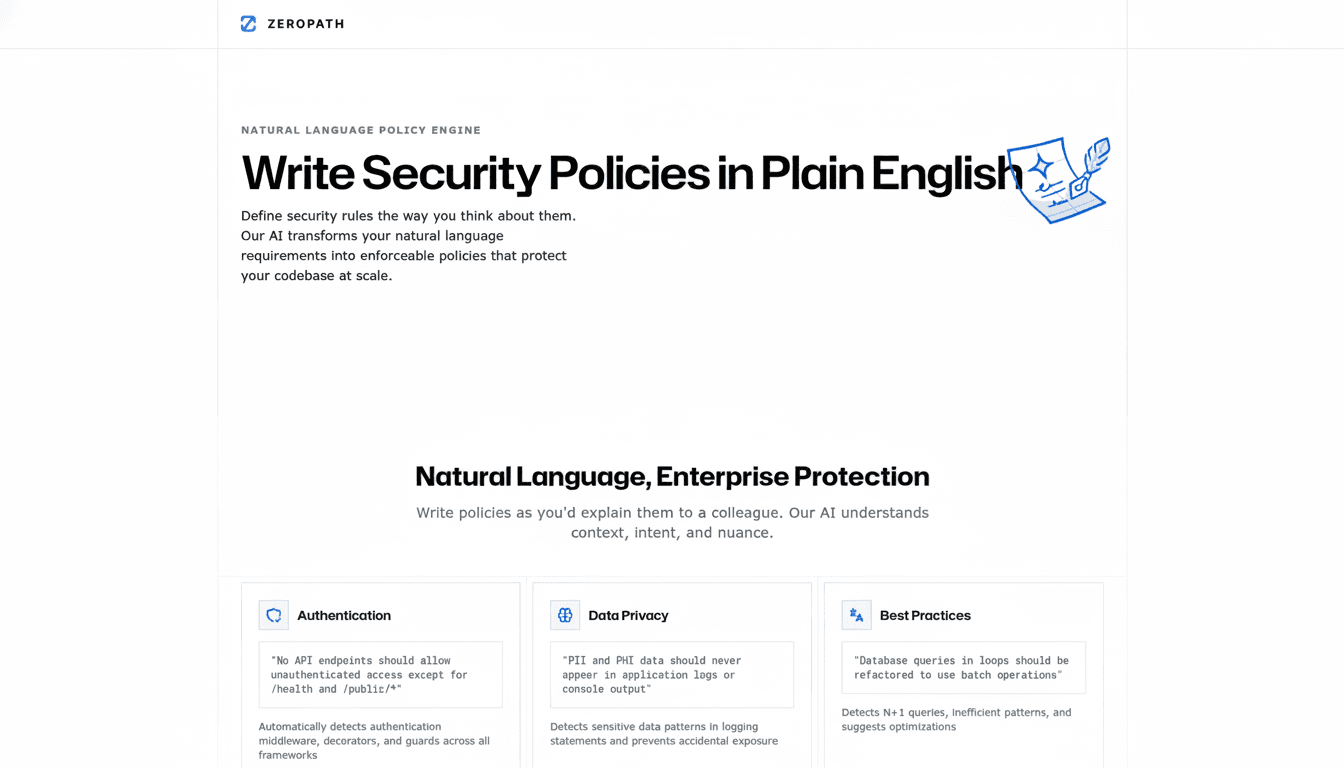
This matters in compliance-heavy environments where audit trails and consistent enforcement across codebases are non-negotiable. When policies live in separate configs across SAST, SCA, and secrets modules, they can drift out of sync over time, leaving coverage gaps that auditors will find even if developers don't. With Snyk, achieving that consistency requires stitching together policies across multiple product surfaces. With ZeroPath, it's one ruleset, applied uniformly.
Auto-fix capabilities and remediation workflow
Snyk's DeepCode AI Fix surfaces remediation suggestions in the IDE, PR comments, and the web dashboard. The feature is gated behind the Ignite and Enterprise plans and is unavailable on the Free and Team tiers. Snyk generates fix PRs for both SAST and SCA findings, and teams can configure custom templates for how those PRs are delivered.
ZeroPath generates patches for both SAST and SCA with human-in-the-loop approval on by default. For dependency vulnerabilities, the system walks up to 5 hops through transitive chains to locate an upgradable parent and automatically regenerates lockfiles when conflicts arise. Fixes post as inline code suggestions that developers apply with one click. After a fix is merged, ZeroPath verifies that the vulnerability is actually gone before closing the issue in the dashboard. Issues close on actual resolution, not when the PR lands.
Scan speed and developer experience
Snyk Code scans without building the project first, finishing in seconds to minutes. Its IDE plugins and PR checks provide developers with real-time feedback, and the Snyk CLI integrates with most CI pipelines with minimal configuration.
ZeroPath targets sub-1-minute PR scans with no configuration required. Every finding comes with a generated fix delivered directly in the PR, so developers review a patch instead of a raw vulnerability report. The AI validation layer runs before a finding ever surfaces, keeping false positives low enough that alerts stay actionable.
The difference is what happens after the scan. Snyk surfaces findings; ZeroPath surfaces findings with fixes attached, and confirms the fix actually worked after the merge.
Pricing and enterprise scale
Snyk's pricing starts at $25 per developer per month for its Team tier, which is capped at 10 developers. Teams of 11 or more move to the Ignite tier at $1,260 per developer per year, with custom enterprise contracts available for $50,000 or more annually for larger organizations. That cost compounds quickly when you factor in the separate modules Snyk sells at the Team tier: Code, Open Source, Container, and IaC, each with its own pricing. At the Ignite and Enterprise tiers, all products are bundled together.
ZeroPath comes in at $1,000 per month plus $60 per developer per month, covering SAST, SCA, and secrets detection together. No module splitting, no separate SKUs for each scan type.
At scale, the math matters. A 50-developer team falls on Snyk's Ignite tier (the applicable plan for teams over 10 developers) at $1,260 per developer per year, totaling roughly $63,000 annually based on current list pricing. The same team on ZeroPath runs around $48,000 annually and includes AI validation, fix generation, and business logic detection.
For enterprise buyers, ZeroPath holds SOC 2 Type II certification and has ISO 27001 in progress.
Why ZeroPath is the better choice
ZeroPath was built from the ground up around AI-driven code understanding, not pattern matching with AI layered on top. Where Snyk Code flags suspicious patterns and leaves your team to verify, ZeroPath traces vulnerabilities from source to sink, validates each finding with AI, and ships a fix directly in the PR. That means fewer false positives and less triage work before anyone writes a line of remediation code.
The Commenda evaluation put a number on it: Commenda found 4x more real vulnerabilities after switching to ZeroPath. In that evaluation, the gap traced back to business-logic vulnerability detection: broken access control, authentication bypass, and flawed transaction sequencing, the category rule-based engines miss by design.
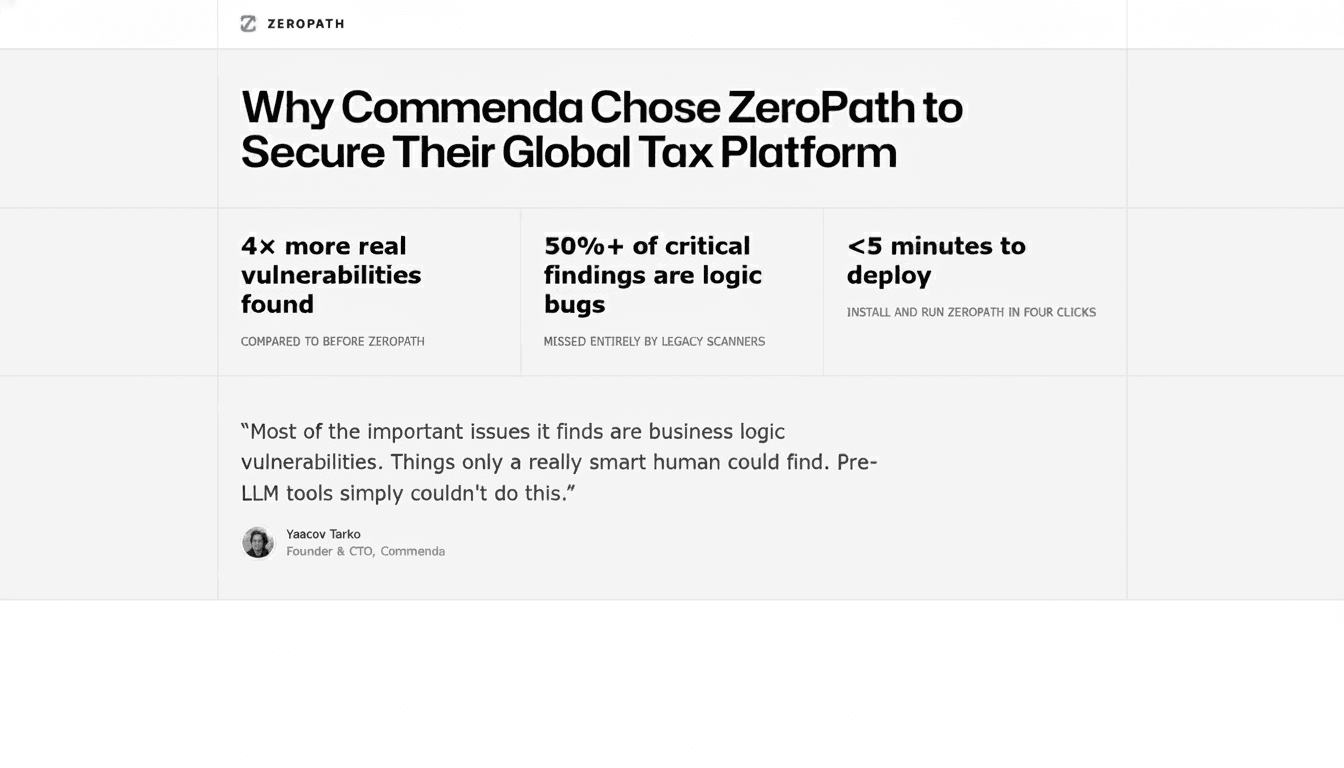
Setup takes minutes. No custom rules, no build dependencies, no tuning required before you see value.
Final thoughts on selecting your SAST platform
If your current scanner surfaces thousands of findings, half of which are noise, you need AI validation to run before alerts hit your dashboard, not after. ZeroPath traces vulnerabilities from source to sink, confirms each one with context-aware analysis, and auto-generates fixes that your developers can review in the PR. Less triage work, more real bugs fixed, and a setup that takes minutes. Run a scan on your repo and compare what surfaces.
FAQ
How should I decide between ZeroPath and Snyk for my application security needs?
Choose ZeroPath if you need business-logic vulnerability detection, lower false-positive rates, and automated fix generation across SAST and SCA on a single platform. Choose Snyk if your primary concern is developer IDE integrations and you're already embedded in their ecosystem across multiple product modules.
What's the main technical difference in how ZeroPath and Snyk detect vulnerabilities?
ZeroPath uses AI validation as a core scanning step that reads code contextually to trace execution paths and spot business logic flaws, while Snyk Code applies AI on top of a pattern-matching engine inherited from DeepCode. This architectural difference is why Commenda found 4x more real vulnerabilities after switching to ZeroPath, while producing fewer false positives.
Which tool is better for teams already struggling with false-positive fatigue?
ZeroPath reduces false positives by up to 75% through AI validation before findings surface, making it the better choice when the triage backlog is already overwhelming your team. Snyk's pattern-matching foundation can still produce noisy results in complex codebases where the AI and the underlying rules disagree on context.
What should I expect during the migration from Snyk to ZeroPath?
ZeroPath requires no build dependencies or custom rule configuration to start, so setup takes minutes. You'll gain unified policy management for SAST, SCA, and secrets on a single platform, eliminating the need to stitch together separate policies across Snyk's Code, Open Source, Container, and IaC modules.
How does pricing compare when factoring in the features each platform includes?
ZeroPath costs $1,000/month plus $60 per developer per month and includes SAST, SCA, secrets detection, AI validation, and fix generation together. Snyk starts at $25/developer/month but charges separately for Code, Open Source, Container, and IaC modules, with enterprise contracts frequently exceeding $50,000 annually. Add-ons like DeepCode AI Fix are gated behind Ignite and Enterprise tiers.