
You need a tool that finds real bugs, cuts false positives, and doesn't slow down your developers. DryRunSecurity offers contextual PR analysis scoped to the diff and a separate DeepScan Agent for full-repo scanning; ZeroPath runs full-repo scans continuously on every PR in under a minute, with AI validation, inline fixes, and patch verification built into the same workflow. The differences that matter are detection coverage, scan speed, and whether the tool stops at a finding or applies a verified patch.
TLDR:
- DryRunSecurity analyzes PR diffs for context-dependent risks and offers a separate DeepScan Agent for full-repo scanning; ZeroPath scans the full repo on every PR in under a minute, catching cross-file vulnerabilities without a separate scheduled process
- ZeroPath scans PRs in under a minute and delivers fixes inline; DryRunSecurity explains findings but leaves remediation to developers
- ZeroPath's AI traces source-to-sink paths and validates findings before surfacing them, cutting false positives by up to 75% and finding up to 2x more real vulnerabilities
- Both tools accept custom rules in plain English, but ZeroPath's targeting system supports org-level inheritance and repository context to cut false positives further
- ZeroPath replaces SAST, SCA, and secrets scanning with one AI-native platform that detects, remediates, and verifies vulnerabilities in a single PR workflow
What is DryRunSecurity?
DryRunSecurity is a code security tool built around the company's Contextual Security Analysis (CSA) engine. The engine layers three types of context: static context from the codebase structure, change context from what was modified in the PR, and app context from the application's architecture and change history.
The product runs as a GitHub and GitLab application, performing contextual analysis during pull requests. It also offers a DeepScan Agent for broader repository analysis across files, modules, and historical code paths. The detection scope covers logic flaws, authorization gaps, and IDOR vulnerabilities. DryRunSecurity also integrates with Slack for notification and supports AI coding agents.
What is ZeroPath?
ZeroPath is an AI-native application security platform that replaces your SAST, SCA, and secrets-scanning products with one AI-validated scanner. Where legacy scanners flood teams with noisy findings, ZeroPath uses AI to validate every result before it surfaces, cutting false positives by up to 75% and surfacing up to 2x more real vulnerabilities.

The core workflow is built around the pull request. When a developer opens a PR, ZeroPath scans it in under a minute, identifies confirmed vulnerabilities, and delivers a fix inline, without any configuration required. The AI reads actual code logic instead of matching against static rule sets, so it catches business-logic flaws and complex vulnerability classes that pattern-based engines routinely miss.
ZeroPath covers the full detection and remediation cycle across web apps, APIs, and infrastructure-as-code, with SOC 2 Type II certification and ISO 27001 in progress.
Pull request scanning and developer workflow integration
Both tools can comment on pull requests, but the workflows they fit into differ in ways that matter for day-to-day engineering.
ZeroPath runs in under a minute per PR scan and delivers fixes directly inside the pull request, so developers get actionable remediation without leaving their review queue. Because Zeropath requires no configuration to get started, security feedback appears from the first scan, not after a weeks-long tuning process.
DryRun Security analyzes code changes with contextual rules, flagging what changed and why it might matter. The focus is on change-level context instead of full repository analysis, which can surface relevant signals quickly but may miss vulnerabilities that only appear when tracing across multiple files or call chains.
Speed and fix delivery within the PR are two of the clearest differentiators, but the choice also depends on scan scope, false-positive tolerance, and whether your team needs full-repo dataflow tracing or change-level context. On the dimensions of scan time and in-PR remediation, ZeroPath's sub-minute PR scans and inline fixes are concrete advantages. On scan scope and AI-validated findings, the gap widens further toward ZeroPath for teams running complex, multi-service codebases.
Full repository scanning and deep analysis
ZeroPath runs two distinct scan types with different scopes. Full scans cover the entire repository, scanning every file, giving the AI a complete view of the codebase to trace data flows across module boundaries, catch vulnerabilities that only appear when two distant code paths interact, and produce fixes that account for how the surrounding code actually works. PR scans are diff-focused, analyzing changed files and their context, with AI validation applied in that diff scope. Both happen continuously, on every PR, in under a minute.
DryRun Security also offers full-repo scanning through its DeepScan Agent, which scans across files, modules, auth flows, dependencies, and historical code paths. DeepScan runs on demand, on a schedule, or before major releases, and takes several hours to complete. The application context it builds carries forward: subsequent PR evaluations can be informed by the broader risk picture from the last DeepScan run. That said, the PR analysis itself is scoped to the diff, so the depth of cross-file tracing at the PR level depends on when the most recent DeepScan run occurred. Between runs, a change that introduces a cross-file vulnerability may not be caught until the next scheduled scan.
For teams that need cross-boundary vulnerability detection on every commit, the distinction is whether full-repo tracing runs live as part of the PR workflow or feeds in asynchronously from a prior run. ZeroPath traces source-to-sink paths across the full codebase on every PR in under a minute: not as a periodic context refresh, but as a complete trace on every single commit.
Detection capabilities and vulnerability coverage
ZeroPath and DryRun Security take fundamentally different approaches to finding vulnerabilities, and those differences show up fast in real codebases.
ZeroPath's AI-native SAST uses dataflow tracing from source to sink to map vulnerability paths across the codebase, then applies AI to confirm whether each path is actually reachable and exploitable before surfacing a finding. That combination catches business logic flaws, authentication bypasses, and complex multi-step attack chains where the bug only appears when components interact. Rule-based scanners miss those classes entirely because they match patterns without checking whether a path is actually reachable. Coverage spans SAST, SCA, secrets, and IaC in a single scan. The result: up to 75% fewer false positives compared to pattern-based SAST tools and up to 2x more real vulnerabilities detected.
Research on developer security workflows documents a well-known industry problem: false positives consume developer time that should go toward fixing real bugs. ZeroPath's AI validation step solves this directly by confirming reachability before a finding reaches a developer.
DryRun Security's CSA engine assesses PR diffs by layering three types of context: static context from codebase structure, change context from the diff itself, and app context from architecture and change history. Because the analysis is scoped to the diff by design, its view of the codebase is bounded by what changed in the PR. That architectural boundary means tracing whether a change is exploitable in the context of how surrounding components actually behave requires visibility beyond the diff itself, a constraint that applies to any diff-scoped approach.
That scope distinction matters for complex, multi-service codebases. A diff-scoped analysis can identify that a change looks risky in isolation. By design, it is not possible to trace whether an exploit path is actually reachable when the entry point and the vulnerable sink reside in separate files or services outside the PR. That is a structural characteristic of any analysis bounded by the diff.
Tool | Scan Scope | Detection Approach | Remediation |
|---|---|---|---|
ZeroPath | Full scans cover the entire repository across every file to trace data flows and catch cross-file vulnerabilities; PR scans are diff-focused, analyzing changed files and their context with AI validation applied in that scope | Traces code from source to sink, detecting business logic flaws and multi-step attack chains with up to 75% fewer false positives | Generates fixes directly in the pull request with AI-written patches that verify automatically |
DryRunSecurity | Analyzes pull request diffs with contextual analysis; also offers the DeepScan Agent for full-repo scanning across files, modules, and historical code paths | Applies its Contextual Security Analysis engine to assess code paths and developer intent, flagging security-relevant changes | Provides plain-language explanations with suggested remediations for developers to apply manually; automated patch generation and verification are not part of the workflow |
Custom policy enforcement and security rules
DryRunSecurity's Natural Language Code Policies let teams write security rules in plain English, asking questions like "Does this change affect authentication logic?" with no scripting or complex syntax required. Plain-English rules are a step forward from regex-based engines, and ZeroPath takes that further with a targeting system built for precision at scale.
ZeroPath's custom rules also accept plain English, but the targeting system is more precise. Rules are scoped to organization, tag, or repository levels with cascading inheritance, so a policy defined at the org level propagates down unless overridden at a lower tier. Two dimensions control targeting: file patterns using glob syntax (e.g., src/api/** or *.py) to limit a rule to specific files, and scope level across organization, tag, or individual repository.
A custom rules-only mode disables all built-in scanning and runs only the policies your team defines. Teams can also provide repository context describing auth layers, deployment boundaries, or sandboxing constraints. When ZeroPath knows a code path is gated behind an auth layer or isolated within a sandbox, it can rule out findings where that constraint already prevents exploitation, reducing false positives that a policy written without that context would still surface.
Automated remediation and fix generation
ZeroPath closes the remediation loop inside the pull request. DryRun Security stops at the finding. That difference in where each tool's job ends is the clearest practical dividing line between them. ZeroPath generates fixes directly in the pull request. When a scan completes, developers get a remediation suggestion alongside the finding, in the same workflow they're already in. No context-switching to a separate dashboard, no ticket filed for a backlog that may never clear.
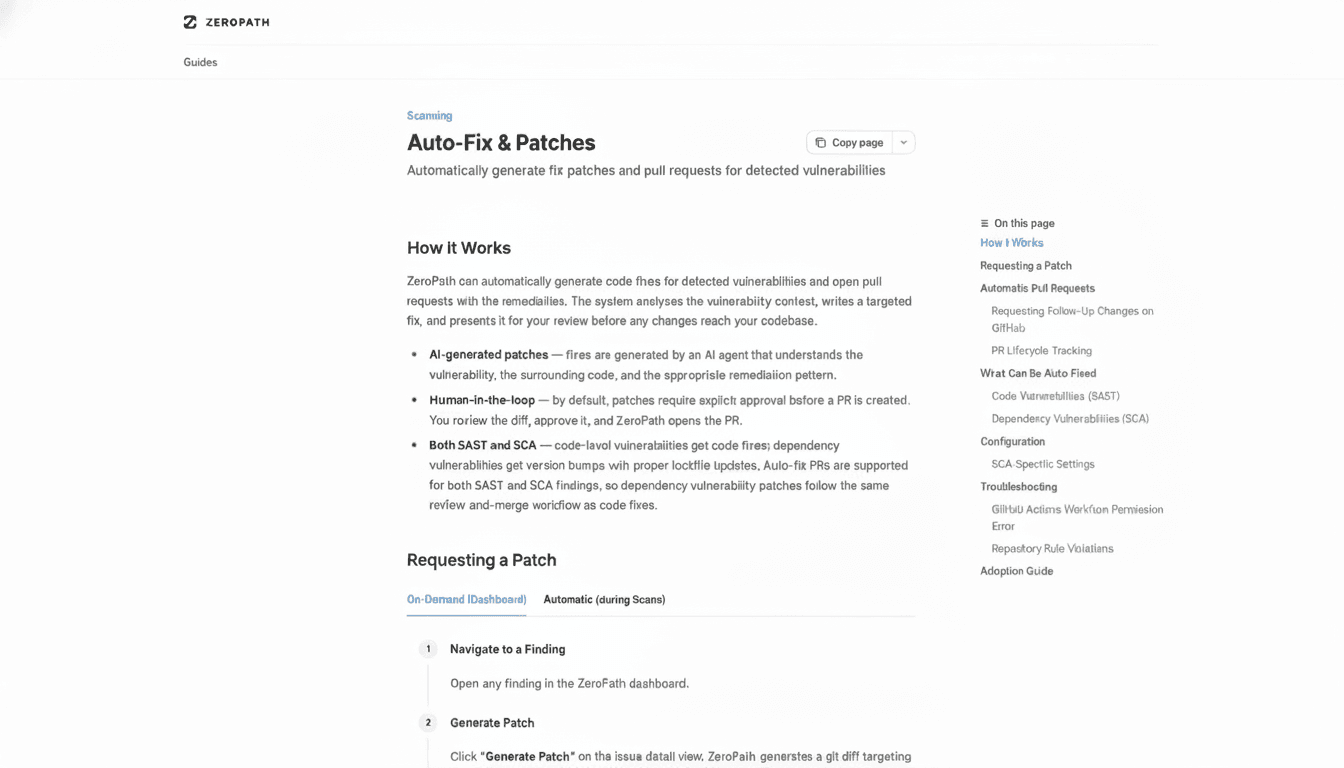
DryRun Security's focus is on explaining findings to developers in plain language. Understanding a vulnerability is a prerequisite for fixing it, but it is not the fix. A developer who understands the finding still has to write the patch themselves, context-switch out of the review queue, and verify the result manually, steps that compound across every finding and push remediation time up.
For security teams measured on mean time to remediation, that gap matters. Fix generation that lands in the PR keeps velocity up. Findings that require a manual remediation step, however well-explained, add friction back into the cycle.
Why ZeroPath is the better choice
Full-repo scanning with AI validation changes the economics of security review: your team spends time on confirmed vulnerabilities, not triage. While tools like DryRun Security analyze pull request changes with contextual rules scoped to what changed, ZeroPath reads the entire codebase as a security engineer would, tracing data flows from source to sink across every file and reasoning about whether a vulnerability is actually reachable and exploitable in your specific codebase.
That distinction shows up in practice. ZeroPath's AI-validated dataflow analysis finds up to 2x more real vulnerabilities and produces up to 75% fewer false positives compared to pattern-based SAST tools. The relevant comparison with DryRunSecurity is structural: diff-scoped contextual analysis does not trace source-to-sink paths across the full repository, so vulnerabilities that span file boundaries or service layers fall outside its view. With Zeropath, your team spends time on bugs that matter, not triaging noise.
Speed is the other side of this. PR scans are complete in under a minute, and ZeroPath does more than surface findings. It writes the fix, opens it in the PR, and verifies the patch by re-scanning to confirm the vulnerability is no longer present before the fix reaches a reviewer. Detection, remediation, and patch verification all happen in a single workflow, with zero configuration required to get started.
For teams that need audit-ready controls, ZeroPath is SOC 2 Type II certified and covers SAST, SCA, secrets, and IaC scanning from one dashboard.
Final thoughts on ZeroPath vs DryRunSecurity for your team
The right tool depends on what your team needs to accomplish. DryRunSecurity's contextual analysis and plain-language explanations serve teams focused on change-level awareness during code review. ZeroPath covers that ground and goes further: full-repo scanning, AI-validated findings with up to 75% fewer false positives, and fixes that land directly in the PR without a manual remediation step. For teams that need detection, remediation, and verification in one workflow without spending review cycles on noise, ZeroPath takes the work all the way from finding to verified fix, where other tools stop at the finding. Scan your repository for free and see the difference firsthand.
FAQ
How does ZeroPath reduce false positives in static application security testing?
ZeroPath uses AI to validate every finding before surfacing it, tracing data flows from source to sink and verifying that vulnerabilities are actually reachable and exploitable in your specific codebase. This cuts false positives by up to 75% compared to pattern-based SAST tools, which flag suspicious code without understanding whether it can actually be exploited.
What's the main difference in how ZeroPath and DryRun Security detect vulnerabilities?
ZeroPath scans entire repositories and traces vulnerabilities across multiple files to catch business logic flaws and complex multi-step attack chains. DryRun Security analyzes pull request diffs with contextual analysis focused on what changed, which can miss cross-file vulnerabilities that only appear when tracing interactions between distant code paths.
Does ZeroPath require configuration before it starts finding real vulnerabilities?
No. ZeroPath runs with zero configuration and delivers AI-validated findings with inline fixes from the first scan in under a minute, not after weeks of tuning rules. No training or rule calibration is required before the tool surfaces vulnerabilities.
Can I run ZeroPath alongside my existing SAST tool during evaluation?
Yes. ZeroPath is SOC 2 Type II certified and can run in parallel with your current tool, so you can compare coverage directly. The AI validation means you'll see up to 75% fewer false positives and up to 2x more real vulnerabilities, making the comparison clear before you fully migrate.
How do security engineers rate ZeroPath's accuracy for CI/CD pipeline integration?
ZeroPath scans PRs in under a minute and delivers verified fixes inline, so security feedback arrives during code review without blocking the pipeline. The AI validates findings before surfacing them, so developers triage real bugs instead of spending time on false alarms that slow down CI/CD workflows.