
ZeroPath and Aikido both consolidate SAST, SCA, secrets, and IaC into one interface with CI/CD integration, but the way they generate and validate findings is fundamentally different. One uses AI to reason about code context and filter out non-exploitable results before they reach your backlog. The other relies more heavily on pattern-matching engines, with some AI-assisted triage layered on top. It surfaces more findings up front, requiring developer review to separate what matters. If your team already spends too much time triaging false positives, the detection model matters more than the feature count.
TLDR:
- ZeroPath traces vulnerabilities from source to sink before surfacing them, cutting false positives by up to 75% compared to pattern-matching engines.
- Aikido bundles open-source scanners into one dashboard but inherits the false-positive rates and coverage limits of rule-based detection.
- ZeroPath covers 15+ languages for SAST and 35+ SCA ecosystems across major package managers and language-specific registries.
- Aikido starts at $350/month for 10 users; ZeroPath runs $1,000 base + $60/developer with no plan-level feature gating.
- ZeroPath generates patches, opens PRs, and verifies fixes post-merge: full remediation beyond detection.
What is Aikido Security?
Aikido Security is a developer-focused application security tool built for startups and mid-market companies that want to reduce tool sprawl across security categories. It covers SAST, SCA, secrets detection, DAST, infrastructure-as-code scanning, and container security. Aikido markets itself around simplicity and applies default filters to limit the volume of findings it surfaces.
Aikido's approach differs from AI-native scanning in the way findings are validated. Its engine applies rule-based detection with some AI-assisted triage layered on top, which keeps the architecture familiar, but it inherits the false-positive rates that come with that model. Teams still spend time triaging findings that turn out to be non-exploitable in their specific codebase context.
Aikido offers a free tier, making it accessible to teams doing early-stage security work. It integrates with common source control providers and surfaces findings in a dashboard, which slows the feedback loop for developers who work primarily in pull requests.
For teams that need compliance reporting, Aikido includes SOC 2 and ISO 27001 report generation features.
What is ZeroPath?
ZeroPath is an AI-native application security platform that covers SAST, SCA, secrets scanning, and IaC in a single offering, with AI validation at every stage of the pipeline. The result is up to 75% fewer false positives than traditional tools, so your team spends time fixing real vulnerabilities instead of triaging whether a finding is exploitable.
ZeroPath's detection model separates it from tools that bolt AI onto a rule-based engine. Pattern matchers catch known vulnerability signatures, but they are not built to reason about whether a missing authentication check in one service actually exposes a resource in another, or whether a seemingly harmless code path becomes dangerous given the surrounding business logic. ZeroPath's AI-driven AppSec agent reads code the way a security engineer would. It's built to reason about authentication flaws, broken access control, and logic-layer issues that static rules miss by design.
The pipeline goes past detection. ZeroPath generates patches, opens PRs, and verifies that fixes actually resolved the issue after the code merges.
AI-native detection vs bundled scanner approach
ZeroPath builds its detection engine around AI that reads code the way a security engineer would: following data flows, understanding context, and tracing vulnerabilities from source to sink. The tool catches business logic flaws and complex, multi-step vulnerabilities that purely rule-based scanners miss by design.

Aikido Security takes a different approach. It aggregates output from multiple open-source scanners, including Opengrep for SAST, into a unified dashboard. That bundling reduces tool sprawl, but the underlying detection remains rule-based. Opengrep includes taint tracking, which covers data-flow patterns with well-defined sources and sinks, with SQL injection as the canonical example. What taint rules can't express is semantic intent: whether an authentication check that exists in one module actually applies to a resource path in another, or whether a missing validation step breaks a trust boundary that only makes sense given the surrounding business logic. Tools that bundle open-source engines typically layer AI-assisted triage or graph-based reachability analysis on top to compensate for this gap. That helps reduce noise after the fact, but the raw findings still originate from engines that were not built to reason about code semantically, and that is where pattern-matching rules fall short.
The practical consequence shows up in triage. ZeroPath runs AI validation on every finding before surfacing it, cutting false positives by up to 75% compared to traditional scanners. Aikido applies some AI-assisted deduplication and prioritization, but the raw findings still originate from engines that weren't built to reason about code semantically.
Coverage impact
- ZeroPath catches business logic vulnerabilities that have no static rule because the AI analyzes intent and data flow instead of matching known bad patterns.
- Aikido's scanner aggregation provides broad coverage across vulnerability classes, but is limited by what its underlying open-source engines can express as rules.
- ZeroPath produces validated, fix-ready findings (patches generated and PRs opened automatically). Aikido surfaces findings that still require developer judgment for confirmation and remediation.
For teams dealing with false-positive fatigue, the architectural difference matters more than the feature checklist.
Language and framework coverage
Aikido's SAST layer covers 19+ languages, including JavaScript, TypeScript, Python, Go, Ruby, PHP, Java, C#, Kotlin, and Rust, with framework-specific rules for React, Django, Rails, and Spring. Across all its scanner types, the count is broader still, though SAST coverage alone is narrower than dedicated tools.
ZeroPath's SAST supports 15+ languages without requiring compilation or framework-specific rule packs, including C/C++, C#, Rust, Kotlin, Scala, Dart, Elixir, Nim, and AL (Business Central), in addition to the languages both tools share.
ZeroPath | Aikido | |
|---|---|---|
SAST languages | 15+ | 19+ languages |
Requires compilation | No | No |
SCA ecosystems | 35+ | Major ecosystems |
IaC formats | Terraform, K8s, Docker, CloudFormation, Azure ARM, Helm, GitHub Actions | Terraform, K8s, Docker, CloudFormation, Helm, Azure ARM/Bicep |
For SCA, ZeroPath covers 35+ ecosystems across major package managers and language-specific registries. IaC scanning extends to GitHub Actions workflows, catching CI/CD pipeline misconfigurations that most scanners skip entirely.
Pricing and deployment model
Aikido's paid plans start at $350/month with 10 users included, scaling to $8,000/month at higher tiers. That range covers PR security reviews, Jira and compliance tool integrations, on-prem scanning, fuzzing, and malware detection, along with expanded repository and container image limits. Smaller teams frequently flag the jump from free to $350/month in public user reviews, describing it as hard to defend before security has its own budget line.
ZeroPath prices at $1,000/month base plus $60 per developer, with a free Personal Workspace tier for individual developers who want to run scans without a commitment. A 10-person engineering team lands at $1,600/month (base $1,000 + 10 developers × $60), and there is no plan-level feature gating. PR scanning, auto-patching, custom rules, and compliance reporting all come included at that price.
On compliance: Aikido holds SOC 2 Type II and ISO 27001 certifications. ZeroPath is SOC 2 Type II certified, with ISO 27001 in progress.
Why ZeroPath is the better choice
ZeroPath takes a fundamentally different approach to application security than Aikido. Where Aikido layers security checks across multiple surfaces, ZeroPath focuses on what actually matters to engineering teams: finding real vulnerabilities in application code without adding triage overhead.
The core difference is in how findings get validated. ZeroPath uses AI to trace vulnerabilities from source to sink, verify reachability, and confirm exploitability before a finding ever surfaces. That means fewer false positives cluttering your backlog and more signal your team can act on.
A few concrete reasons security teams choose ZeroPath over Aikido:
- As one case study example, ZeroPath found 170 valid bugs in the curl project, including business logic flaws that rule-based engines had missed.
- AI validation reduces false positives by up to 75%, so engineers spend time on actual bugs instead of triaging noise.
- As scans complete, fixes land in pull requests in under a minute, so security stays in the developer workflow without slowing it down.
- Zero configuration required to get started. Aptos Labs went from first call to production scanning in under 2 days.
- In published benchmark evaluations, ZeroPath found more real vulnerabilities and fewer false positives than the pattern-matching tools tested.
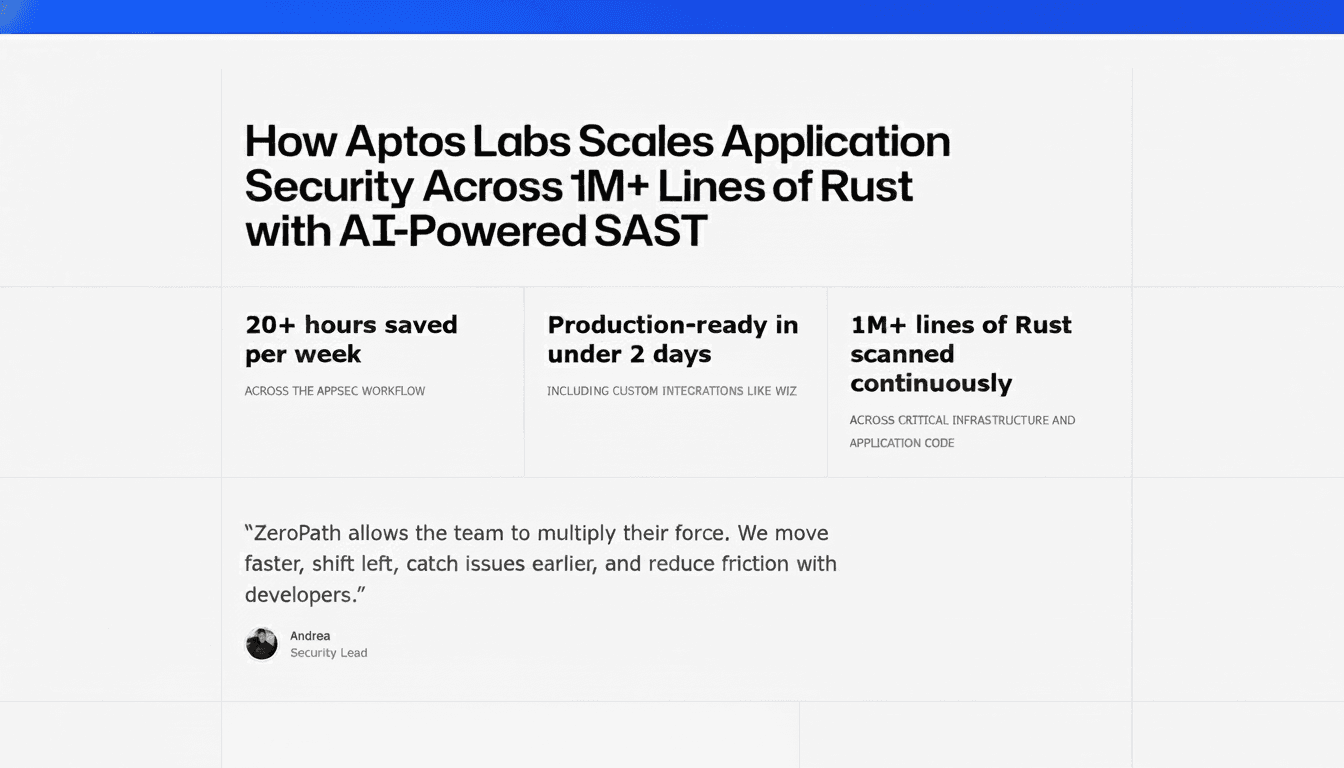
ZeroPath covers SAST, SCA, and secrets detection in one place. It holds SOC 2 Type II certification, and ISO 27001 is in progress. If your team needs coverage that goes beyond surface-level scanning and delivers results that engineers will actually trust, request a demo to see what ZeroPath catches in your codebase.
Final thoughts on ZeroPath and Aikido for application security
Both platforms reduce tool sprawl, but they take different paths to get there. Aikido aggregates open-source scanners into one interface, which improves visibility but keeps false-positive rates closer to those of the underlying pattern-matching engines, up to 75% higher than AI-validated detection. ZeroPath rebuilds detection from the ground up with AI that traces vulnerabilities through your actual code paths, catching business logic flaws that rules-based engines can't see. If triage is eating your team's time and you want findings you can trust, see what ZeroPath catches in real scans.
FAQ
How does ZeroPath use AI to reduce false positives compared to traditional SAST tools?
ZeroPath traces vulnerabilities from source to sink through your actual code paths and verifies exploitability before surfacing a finding, cutting false positives by up to 75% compared to pattern-matching engines. Pattern matchers flag anything that looks like a vulnerability signature; ZeroPath's AI reads the surrounding logic to confirm whether the flaw is reachable and exploitable in your application.
What should I expect during onboarding if I'm switching from a legacy SAST tool to ZeroPath?
First-time full scans take longer while ZeroPath indexes your codebase and builds application context, but subsequent scans run roughly 10x faster, and PR scans finish in under a minute. Aptos Labs went from first call to production scanning in under 2 days with zero configuration required. For your own team, connecting GitHub, GitLab, or Bitbucket repositories is all it takes to start scanning without writing rules or tuning engines.
How does ZeroPath compare to Opengrep for static code analysis?
Opengrep is a pattern-matching engine with taint tracking for well-defined source-to-sink flows, while ZeroPath builds AI detection from the ground up. Opengrep finds known vulnerability patterns quickly; ZeroPath catches business logic flaws and multi-step vulnerabilities that lack static signatures because the AI reasons about code semantics and data flow instead of matching rules.
Does ZeroPath require me to build or compile my code before scanning?
No. ZeroPath analyzes source code directly across 15+ languages without requiring compilation, build artifacts, or framework-specific configuration, keeping setup fast and eliminating the infrastructure overhead that tools like CodeQL impose.
Which tool is better suited for a small engineering team without dedicated AppSec headcount?
Teams without dedicated AppSec headcount are the ones who can least afford triage overhead. Every hour spent confirming whether a finding is real is an hour pulled from shipping. That cuts in ZeroPath's favor: AI-validated findings and auto-generated patches mean engineers fix real vulnerabilities. Aikido's free tier makes it accessible for very early-stage teams with no security budget at all, and its bundled DAST and container scanning covers a broader surface area. But for any team writing real application code and paying for a tool, ZeroPath's lower false-positive rate reduces the total security work on an engineering team's plate.