
Most static code analysis tools get purchased after a compliance audit and abandoned six months later when developers stop reading the findings. You know this cycle because you've probably lived it. The problem isn't that static analysis doesn't work. It's that pattern matching alone produces so much noise that real vulnerabilities get buried under false alarms, and the tools that claim to fix this can't actually show you a data flow trace proving their findings are exploitable. This guide covers how static analysis actually detects vulnerabilities, why false positive rates matter more than detection breadth, and which technical capabilities separate tools that get used from tools that get tolerated until the renewal comes up.
TLDR:
- Static analysis catches vulnerabilities before code runs by parsing source into ASTs and tracing data flows from untrusted input to sensitive operations
- Traditional SAST tools exceed 50% false positive rates, causing engineers to ignore findings and miss real CVEs buried in noise
- Control flow analysis reveals authentication bypasses and missing authorization checks that pattern matching can't detect
- Fixing vulnerabilities at code review costs 55% less than post-deployment remediation, with audit-ready evidence for SOC 2 and PCI DSS
- ZeroPath uses AI validation to achieve 75% fewer false positives than traditional tools while detecting business logic flaws
What Is Static Code Analysis
Static code analysis inspects source code for security vulnerabilities, bugs, and quality issues without running the application. A SAST tool reads your codebase the way a security engineer would during code review, tracing data flows, checking for dangerous patterns, and flagging exploitable logic before a single line executes in production.
The appeal is timing. Finding a SQL injection in a pull request costs minutes to fix. Finding it after deployment costs far more, in engineering hours, incident response, and compliance exposure. That's the core argument for shift-left security: move detection earlier, where fixes are cheap and blast radius is zero.
For security teams managing dozens of repositories across multiple languages, manual review doesn't scale. Static analysis fills that gap automatically and consistently.
How Static Code Analysis Works
At the lowest level, a static analyzer parses your source code into an abstract syntax tree (AST): a structured representation of every variable, function call, conditional branch, and expression. From there, the tool applies several analysis passes depending on what it's looking for.
There are a handful of distinct techniques that stack on top of each other:
- Parsing and AST construction: raw source code becomes a traversable tree structure
- Pattern matching: rule-based checks flag known-dangerous constructs (e.g.,
exec()with user input) - Data flow analysis: tracks how untrusted input moves through the codebase, source to sink
- Taint analysis: marks external data as "tainted" and flags any path where tainted data reaches a sensitive operation without sanitization
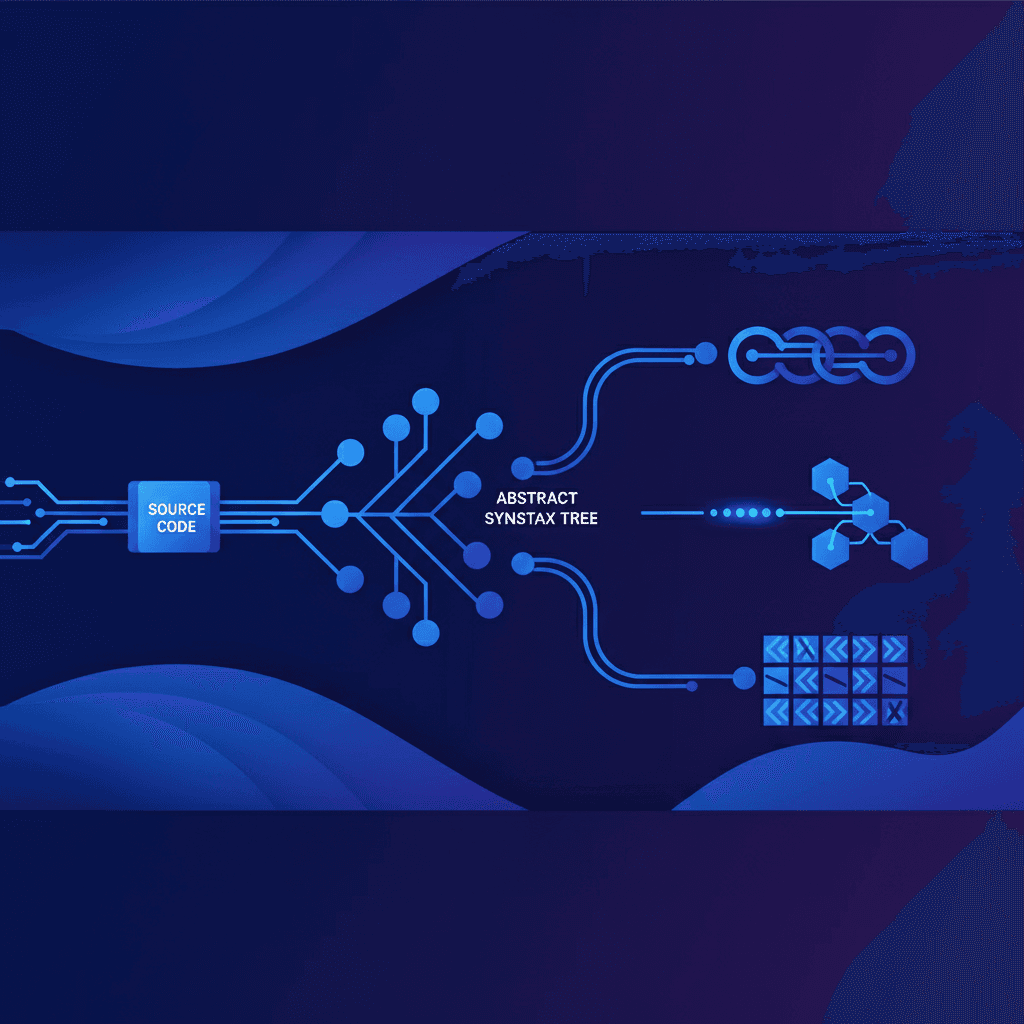
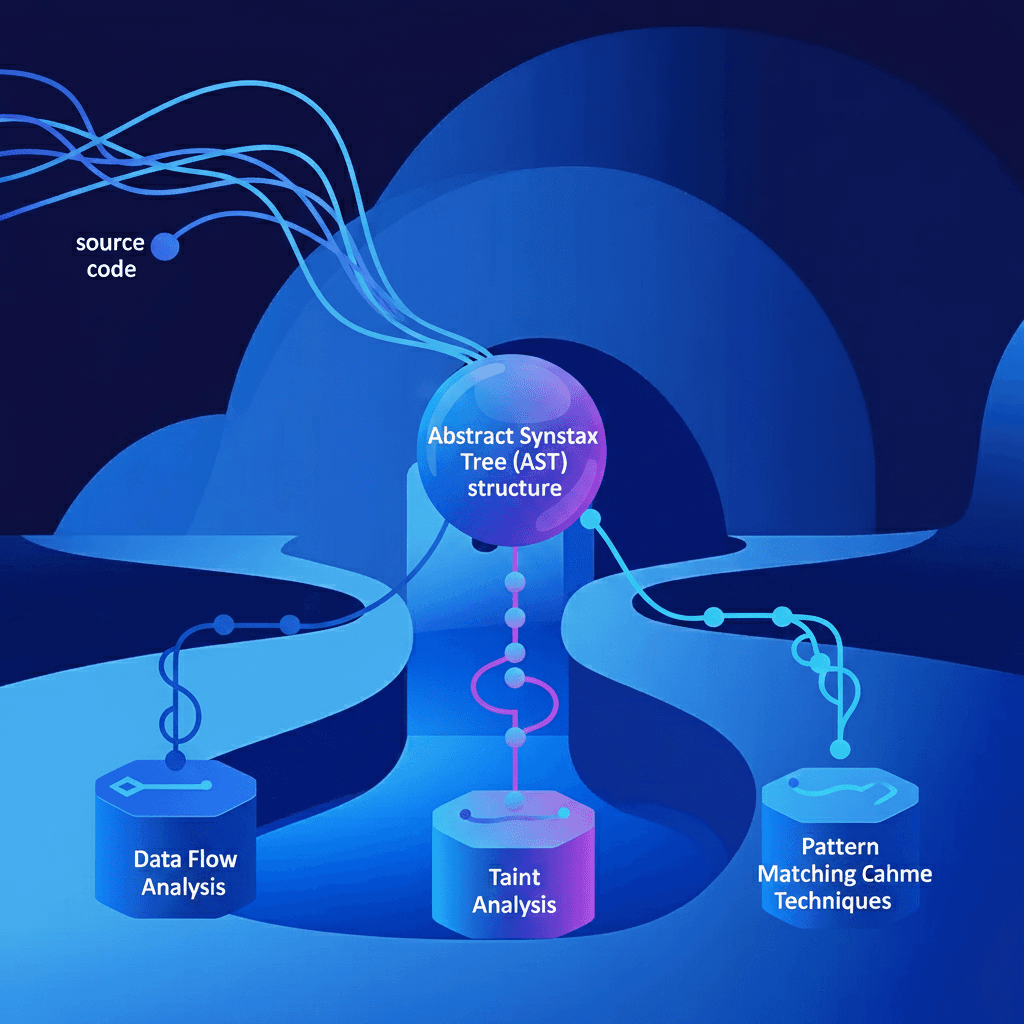
Each layer adds depth. Pattern matching catches obvious issues fast but misses context. Taint analysis catches SQL injection even when the injection point is five function calls away from the vulnerable query.
From Analysis to Results
Once findings are generated, the tool scores and reports them. Traditional tools stop here, which is where false positive rates balloon. A more thorough pipeline adds a validation pass: reviewing whether a finding is actually exploitable given the code's real execution context.
The difference between a good SAST tool and a noisy one often isn't detection breadth. It's what happens after detection: does the tool understand enough about your code to distinguish a real vulnerability from a false alarm?
Core Static Code Analysis Techniques
Control flow analysis is the technique most often skimped on in tool evaluations. Where data flow tracks where information goes, control flow maps every possible execution path through a function: which branches run under what conditions, where exceptions get caught, and where execution can be interrupted or rerouted. That matters for authentication bypass vulnerabilities, where the dangerous path isn't data reaching a sink but code reaching a sensitive operation without hitting the right gate first.
These four techniques become meaningful when they work together. Pattern matching alone flags eval() calls. Add taint analysis and you know whether the argument came from user input. Add control flow and you know whether that input passed through a validation check before arriving.
What Each Technique Catches Best
- Data flow analysis: SQL injection, XSS, SSRF, path traversal
- Control flow analysis: authentication bypasses, missing authorization checks, exception-handling logic flaws
- Taint analysis: any vulnerability where untrusted data crosses a trust boundary
- Pattern matching: hardcoded secrets, insecure API usage, deprecated cryptographic functions
Analysis Technique | Primary Detection Capability | Coverage Scope | False Positive Rate | Ideal Use Case |
|---|---|---|---|---|
Pattern Matching | Known dangerous constructs and anti-patterns like hardcoded secrets, insecure cryptographic functions, and deprecated API calls | Fast surface-level scanning with limited context awareness | High without additional validation layers | First-pass detection of obvious security issues and compliance violations before deeper analysis |
Data Flow Analysis | Injection vulnerabilities including SQL injection, XSS, SSRF, and path traversal by tracking variable movement | Traces how data moves through the codebase from assignment to usage across function boundaries | Moderate, depends on sanitization detection accuracy | Finding vulnerabilities where untrusted input reaches sensitive operations through complex code paths |
Taint Analysis | Any vulnerability where external untrusted data crosses trust boundaries without proper sanitization | Marks external inputs as tainted and follows propagation through transformations and assignments | Moderate to low when combined with sanitization rule libraries | Detecting injection flaws where tainted data reaches sinks five or more function calls from the source |
Control Flow Analysis | Authentication bypasses, authorization flaws, and exception-handling vulnerabilities that pattern matching cannot detect | Maps every possible execution path including conditional branches, exception handlers, and early returns | Low for logic flaws, higher for inferring missing checks | Identifying business logic vulnerabilities where dangerous code paths bypass security gates |
For security leaders comparing top AI SAST tools, the right question to ask vendors is which of these techniques their tool actually runs, and whether they can show a data flow trace for a confirmed finding. Tools that can't produce a source-to-sink trace for injection findings are likely relying on pattern matching alone, which means higher false positive rates and missed business logic vulnerabilities.
Static Code Analysis vs Runtime Code Analysis
Static analysis catches vulnerabilities before code runs. Runtime analysis finds them by running it. Treating these as competing approaches is where AppSec programs go wrong.
The practical difference comes down to visibility. Static analysis has full code coverage but no runtime context. Runtime analysis has runtime context but only sees what actual execution paths reach. A DAST scanner can't find a vulnerability in code its test cases never trigger. A SAST tool can't tell you whether a misconfigured JWT validation is being exploited in staging right now.
When Each Approach Wins
- Static analysis: pre-production, covers 100% of code paths, catches injection flaws, secrets, IaC misconfigurations, and business logic issues before deployment.
- Runtime analysis: post-deployment validation, runtime behavior testing, finding misconfigurations invisible in source code, API fuzzing.
For mature AppSec programs, the decision isn't static vs. runtime. It's sequencing. Static analysis runs in CI/CD to stop vulnerabilities from reaching production. Runtime analysis validates what made it through and finds issues that only appear under real conditions.
The coverage gap runs both directions. Static tools miss vulnerabilities that only manifest at runtime, like race conditions from specific concurrency patterns or auth flaws in third-party dependencies your code calls but doesn't own. Runtime tools miss anything their test suite doesn't exercise, which in a large application is most of the attack surface.
Benefits of Static Code Analysis for Security Teams
Fixing a vulnerability at the code review stage costs a fraction of what it costs post-deployment, with remediation effort reduction at roughly 55% when vulnerabilities are caught before release.
For security leaders, the business outcomes matter more than the technical mechanics:
- Earlier detection means smaller blast radius and no incident response overhead
- Developer-facing feedback in PRs builds security awareness without mandatory training cycles
- Continuous scanning gives audit-ready evidence for SOC 2, PCI DSS, and ISO 27001 without manual effort
- Automated coverage across every commit removes the human review bottleneck that lets vulnerabilities slip through during crunch periods
PCI DSS 4.0 explicitly requires secure development practices and evidence of code review. Static analysis with proper scan history satisfies those controls automatically. The productivity argument is underrated too: tools that include remediation guidance and auto-fix patches integrate security directly into the development workflow.
The False Positive Problem in SAST Tools
False positives erode trust faster than vulnerabilities do. When a tool cries wolf on every third finding, engineers stop listening. That's the real failure mode.
Studies show SAST false positive rates can exceed 50% in practice, and that number climbs with legacy codebases.
The compounding effect: each false positive reviewed wastes triage time, and each ignored alert risks burying a real CVE underneath the noise.
Choosing the Right Static Code Analysis Tool
Most SAST evaluations fail before they start because teams optimize for the wrong thing. Feature checklists don't predict whether a tool will actually get used.
What actually matters for a procurement decision:
- Language coverage across your actual stack, not a marketing matrix
- False positive rate under real conditions (ask for a proof-of-concept on your own code)
- CI/CD integration that doesn't require custom glue code per repository
- Custom rule support for org-specific security policies
- Compliance reporting that maps findings to SOC 2, PCI DSS, or ISO 27001 controls automatically
The ROI question matters for budget justification. The honest answer: tool cost is trivial against one avoided breach, but only if signal-to-noise is high enough that developers act on findings. A tool with 80% false positives gets ignored. An ignored tool has zero ROI.
Scalability deserves more weight than it gets. Test rescan speed on changed files since that's the CI/CD hot path, not the initial full scan.
Integrating Static Code Analysis into CI/CD Pipelines
Getting SAST into CI/CD is less a technical problem than a prioritization one. The tooling exists. The friction is deciding where to place gates and how strict to make them.
Standard integration points worth knowing:
- Pre-commit hooks run fast pattern checks with low latency, but cause high developer friction if misconfigured
- PR scans do diff-focused analysis on changed files only, surfacing findings before merge
- Merge checks block or flag based on severity thresholds
Over 72% of DevSecOps pipelines integrate static analysis at the CI stage. In compliance-heavy industries, that number sits closer to 61% with mandatory controls.
The velocity tension is real. Full codebase scans on every commit kill build times. The fix is scoping: PR scans should analyze only changed files and new findings. Rescan speed on diffs matters far more than initial scan speed for day-to-day workflows.
Failure thresholds need deliberate tuning. Blocking merges on every medium-severity finding produces alert fatigue and developer workarounds. A reasonable starting point: fail checks on confirmed critical and high findings, flag medium findings as informational without blocking. Adjust based on actual false positive rates once you have scan history.
AI and Machine Learning in Static Code Analysis
Pattern matching has a ceiling. It finds what it's been told to look for, nothing more. AI changes that by understanding what code is actually doing, beyond surface patterns.
The practical difference shows up in three places: false positive reduction through exploitability validation, detection of business logic vulnerabilities that have no pattern to match against, and auto-generated fixes that understand a vulnerability's root cause instead of applying a generic template.
Where traditional SAST flags any eval() near user input, an AI SAST scanner checks whether that input is sanitized upstream and whether the code path is reachable. Fewer false positives mean findings get triaged instead of ignored.
ZeroPath: AI-Native Static Code Analysis
Every concept covered in this guide, false positive noise, business logic blind spots, CI/CD integration friction, leads back to the same question: does your current tool actually solve them?
ZeroPath's multi-stage AI pipeline runs validation after detection, filtering non-exploitable findings before they reach your queue. The result is 75% fewer false positives than traditional SAST. It catches authentication bypasses and authorization flaws that pattern matching can't touch, generates auto-fix patches with root cause context, and runs PR scans in under 60 seconds.
SAST, SCA, secrets, and IaC scanning run as a single unified workflow. No stitching together four tools. Trusted by 750+ companies running 125,000+ scans monthly, including catching vulnerabilities in open-source repositories owned by Netflix, Hulu, and Salesforce.
Final Thoughts on Static Code Analysis for Security
Most teams pick static code analysis tools by counting features when they should be measuring noise. A scanner with 80% false positives generates zero value regardless of what vulnerabilities it theoretically detects. Your AppSec program needs findings that survive triage and actually get remediated. See ZeroPath in action on your codebase to compare validated results against traditional SAST output. Security tooling earns ROI when it changes developer behavior, not when it generates reports nobody reads.
FAQ
Static code analysis vs runtime for security testing?
Static analysis inspects source code before execution and provides full code path coverage, while runtime analysis tests running applications but only sees exercised code paths. For AppSec teams, these aren't competing choices: static analysis should run in CI/CD to prevent vulnerabilities from reaching production, and runtime analysis validates what made it through under real conditions.
Best static code analysis tools for reducing false positives?
AI-native SAST platforms that validate exploitability after detection (going beyond simple pattern matching) deliver the lowest false positive rates. Traditional tools can exceed 50% false positives in practice because they flag dangerous patterns without understanding code context: whether sanitization exists upstream, if the code path is reachable, or if the vulnerability is actually exploitable in your specific implementation.
Can static code analysis detect business logic vulnerabilities?
Yes, but only tools that go beyond pattern matching. Traditional SAST catches technical vulnerabilities like SQL injection through known patterns, but AI-powered analysis can identify authentication bypasses, authorization flaws, and workflow manipulation by understanding code intent and control flow: issues that have no signature to match against.
How do I integrate static code analysis into CI/CD without killing velocity?
Run differential scans on PRs that analyze only changed files and surface new findings, not full codebase scans on every commit. Configure failure thresholds strategically: block merges on confirmed critical/high findings, flag medium-severity issues informationally without blocking. Rescan speed on diffs matters more than initial full scan performance for day-to-day development workflows.
What's the ROI of static code analysis for security teams?
Catching vulnerabilities pre-deployment reduces remediation effort by roughly 55% compared to post-release fixes, but ROI collapses if false positive rates are high enough that developers ignore findings. The actual cost avoidance extends well beyond preventing breaches. It's eliminating incident response overhead, satisfying audit controls automatically (PCI DSS 4.0, SOC 2, ISO 27001), and removing the human review bottleneck that lets vulnerabilities slip through during crunch periods.