Your security scanner takes 40 minutes per PR and flags every transitive dependency as critical, even when the vulnerable code path never executes in your application. Most dependency analysis tools weren't built for monorepos where services share workspace packages, and a single vulnerable library could affect many teams or none. Make sure your chosen scanner covers these common failure points: multi-language support that breaks down without separate configs per service, reachability analysis that can't trace call graphs, and scan speeds that make CI the slowest part of shipping.
TLDR:
- Monorepo scanners fail when they lack directory partitioning and differential scanning: most tools rescan millions of lines on every commit.
- ZeroPath scans large monorepos in under 60 seconds and maps findings to specific services, going beyond simple file paths.
- Reachability analysis separates noise from risk by determining if vulnerable dependency code actually executes in your architecture.
- Traditional SAST tools miss business logic flaws because pattern matching cannot trace authorization bypasses across service boundaries.
- ZeroPath delivers validated working patches for monorepos, reducing mean time to remediation from days to hours per finding.
What Are Monorepo Security Scanning Tools?
Monorepo security scanning tools analyze large, unified codebases where multiple services share a single repository. Generic scanners weren't built for this: run one against a real monorepo, and you get hour-plus scan times in the largest codebases, or results that are too noisy to triage.
Three challenges define this space:
- Multi-language support across a single codebase, since monorepos routinely mix Go, Python, TypeScript, and others under one roof.
- Intelligent partitioning to scan only changed portions, keeping CI feedback loops from becoming bottlenecks.
- Application discovery to map each finding to the exact service it affects. Without this, a critical SQL injection surfaces with no indication of whether it lives in your payment service or a low-stakes internal tool.
That last gap is where most traditional scanners quietly fail.
How We Tested Monorepo Security Scanning Tools
The criteria below map to the failure points that surface in production monorepos, not controlled lab conditions.
- Directory partitioning: Can the tool scan subdirectories as independent services and route findings to the right team?
- Differential scanning: Does it analyze only changed code, or does every commit trigger a full rescan?
- Multi-language coverage: Does it support 10 or more languages within a single scan without requiring separate tool configurations?
- Reachability analysis: Can it determine whether a vulnerable dependency's code path is actually invoked, or does it flag every transitive package?
- PR-level VCS integration: Does it post inline comments, block merges, and finish before developers have moved on?
Once a codebase exceeds 500,000 lines, scan performance stops being a minor inconvenience and becomes a hard blocker. That threshold is where tool selection decisions carry real consequences for shipping velocity.
Best Overall Monorepo Security Scanning Tool: ZeroPath
ZeroPath is the only tool in this comparison purpose-built for monorepo architecture, not retrofitted to it through configuration workarounds. It covers every criterion that separates real monorepo tooling from generic SAST applied to a larger codebase: directory partitioning, differential scanning under 60 seconds, multi-language coverage without separate configs per service, reachability analysis that traces actual call graphs, and PR-level integration that posts inline comments and blocks merges before developers move on. Where Checkmarx takes 25 to 45 minutes per full scan and months to deploy, GHAS works only on GitHub and often surfaces findings after the merge, and Snyk Code tops out at pattern-matched signatures, ZeroPath handles the architectural problem every other tool works around.
The AI engine traces vulnerabilities through call graphs across package boundaries, so findings map to your actual attack surface and only flag transitive dependencies that run in production. That’s the reachability gap driving the alert queues Sonar, GHAS, Checkmarx, and Semgrep produce, which engineers eventually ignore.
Three capabilities separate ZeroPath from generic SAST at scale:
- Dependency analysis covers transitive relationships across workspace packages beyond direct imports, so you see the real blast radius of a vulnerable library across every service that consumes it.
- Business logic detection catches authorization bypasses and logic flaws across service boundaries, the vulnerability classes that no rule-based engine (Semgrep, Sonar, GHAS) can express, regardless of how large its rule library is.
- PR-level scanning integrates without per-service pipeline configuration and completes in under 60 seconds, which matters when Checkmarx is still running, and GHAS would fire after the merge.
For CISOs and VPs of Engineering managing a monorepo at scale, ZeroPath is the place to start.
Sonar
SonarQube and SonarCloud are code quality tools that expanded into security over time. Sonar carries organizational trust: the product is widely deployed, recognized by engineering teams, and deeply embedded in many development workflows.
- Security hotspots that flag code patterns requiring human review
- Multi-language support across many programming languages
- IDE integration through SonarLint for real-time feedback
- Quality gates that define severity thresholds for build blocking
Security is a feature of SonarQube, not its purpose. The security hotspot model flags code patterns that might be issues and requires human investigation to confirm, which means alert queues grow and engineers learn to dismiss them without careful review. There is no reachability analysis, no business logic detection, and no auto-remediation. LOC-based pricing scales unpredictably in large monorepos, catching teams off guard at renewal as the codebase grows.
GitHub Advanced Security
GitHub Advanced Security (GHAS) is Microsoft's integrated security offering for GitHub repositories. For monorepos, it provides code scanning via CodeQL, secret scanning, and dependency review through Dependabot. CodeQL runs semantic analysis across multiple languages, which helps when a single monorepo spans services written in Python, Go, and TypeScript.
The structural limitations matter more than the headline feature list. GHAS is GitHub-only, so any services living on GitLab, Bitbucket, or Azure DevOps have zero coverage. CodeQL requires successfully building compiled languages before scanning, so build failures in complex polyglot monorepos can create silent coverage gaps. Scan times on large codebases are slow enough that security findings routinely surface after the merge, not before it. Copilot Autofix generates AI-suggested patches, but they require thorough developer review. The fixes are only as good as what CodeQL surfaces, a scanner limited to pattern-matched vulnerability classes. Business logic flaws and authorization bypasses fall outside what any query-based engine can express. Pricing is per active committer on a 90-day rolling window, which creates billing spikes as contributor counts fluctuate.
Checkmarx
Checkmarx is a veteran SAST vendor with serious enterprise credibility. For monorepos, it offers incremental scanning that avoids re-analyzing unchanged code, and the IDE integrations are polished. That said, Checkmarx's AI capabilities are layered on top of a legacy rule-based engine, not built from the ground up, which shows in both detection depth and management overhead.
Full scans run 25 to 45 minutes on production-scale codebases, making it impractical as a real PR gate. Implementations typically take months: build script configuration, agent deployment, rule tuning, and false-positive baseline work add up before teams get a useful signal. For organizations with dedicated AppSec engineers and the infrastructure budget to match, Checkmarx covers broad ground. Teams without dedicated AppSec staff or the infrastructure budget tend to find that the overhead outpaces the value.
Snyk
Snyk's reputation is built on SCA, and that foundation holds. The dependency database is large, IDE integrations work well, and the developer workflow has genuine traction across many engineering teams.
The weaker surface is SAST. Snyk Code was acquired from DeepCode in 2020 and retrofitted onto a product originally built for dependency scanning. It remains largely pattern-based, which means it catches known vulnerability signatures well but cannot detect authorization bypasses, business-logic flaws, or multi-file data-flow issues that require reasoning about code intent. There are no custom rules, and detection stops at what pre-defined patterns can express.
For monorepos where the relevant risk often lives in service interactions and shared library usage instead of obvious injection patterns, that detection ceiling matters. Snyk is a credible SCA layer, but teams relying on Snyk Code for thorough SAST coverage are working with a tool designed for a different job.
Semgrep
Semgrep is a rule-based SAST engine with genuine developer credibility and a large community rule registry. Its pattern-matching approach is fast, transparent, and customizable, which appeals to security engineers who want explicit control over what gets flagged. Incremental scanning keeps CI times reasonable as codebases grow.
The ceiling is structural. Every finding Semgrep produces is bounded by what rules already exist for it. Business-logic flaws, authorization bypasses, and application-specific vulnerabilities that require understanding the code's intent are outside what any pattern-matching engine can express, regardless of how good the rule library is. Semgrep Multimodal adds an AI triage layer on top of the existing engine, but the detection surface is still defined by rules. ZeroPath takes a different approach: AI replaces the rule engine entirely instead of sitting on top of it.
Rule Maintenance and Detection Limits
- Custom rule writing gives security engineers explicit control, but maintaining those rules as the codebase evolves becomes an ongoing time cost that often falls on whoever has the most security context on the team.
- Cross-service taint tracking for monorepos with shared internal libraries typically requires Semgrep Code (paid), and even then, it operates within the bounds of what rules can express.
- There is no auto-remediation. Semgrep finds issues and stops. Developers receive a finding with context and are responsible for the fix.
Semgrep works as a first-pass detection layer when teams have security engineers willing to invest in rule development and maintenance. The gap is the vulnerability class that no rule covers yet, which is often where the most consequential findings live.
Feature Comparison Table of Monorepo Security Scanning Tools
Directory partitioning and differential scanning are the two rows that reveal whether a tool was designed for this architecture or simply tolerates it.
Feature | ZeroPath | Sonar | GitHub Advanced Security | Checkmarx | Snyk | Semgrep |
|---|---|---|---|---|---|---|
Directory Partitioning | Yes | No | No | No | No | No |
Differential Scanning | Yes | No | No | No* | No | No* |
Business Logic Detection | Yes | No | No | No | No | No |
PR Scan Speed (Large Repos) | Under 1 min | Slow | Slow | 25-45 min | Fast | Fast |
Auto-Remediation | Validated patches | No | AI suggestions | Guidance only | PR + AI fixes | No |
Zero Config Setup | Yes | No | No | No | No | No |
Multi-VCS Support | GitHub, GitLab, Bitbucket, Azure DevOps | All | GitHub only | All | All | All |
Build Requirement | None | None | Required for compiled | Required (legacy CxSAST only) | None | None |
Reachability Analysis (SCA) | Yes | No | No | No | Partial (JavaScript, Java, Python only) | No |
Custom Rules | Natural language | Limited (XPath/template-based) | QL query language | CxQL query language | No | DSL/pattern syntax |
Implementation Time | Under 5 minutes | Hours | Days | Months | Hours | Hours |
False Positive Rate | 75% fewer | High | High | High (requires tuning) | Medium | High at scale |
* Semgrep performs file-level incremental scanning but does not perform AI-powered diff analysis. The Differential scanning row measures AI-driven diff analysis that avoids full-pipeline re-runs for small changes. Checkmarx has file-level incremental scanning but not AI-powered diff analysis.
Why ZeroPath Is the Best Monorepo Security Scanning Tool
ZeroPath handles enterprise Rust monorepos with more than 1,000,000 lines of code. And no configuration is required for polyglot architectures. Connect the repository and scan.
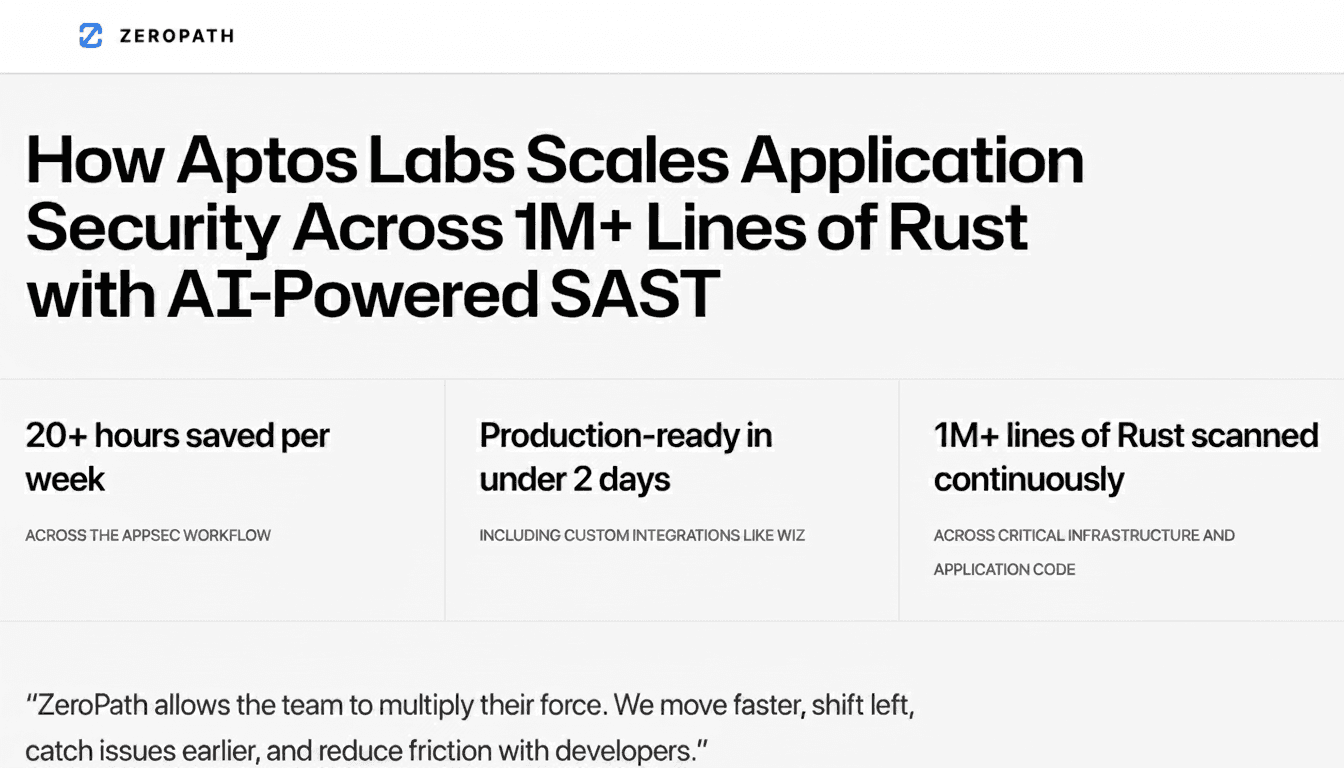
The architectural difference matters here. Directory partitioning, differential scanning under 60 seconds, and service-aware application discovery were part of the architecture before the first customer went live, not added as configuration workarounds, which is why onboarding takes minutes instead of months.
Patch quality is where the gap widens. When ZeroPath surfaces an authorization bypass or business-logic flaw, it delivers a validated, working patch, not generic remediation guidance. For security teams tracking mean time to remediation, that difference is measured in hours per finding, and across dozens of services, it compounds fast.
Final Thoughts on Scanning Tools for Monorepos
If your current dependency analysis tools can't tell you which service contains a critical vulnerability or require full rescans on every commit, you're fighting architecture with the wrong equipment. The scanning approach designed for single-service repositories breaks visibly when applied to monorepos at scale. Security teams managing large unified codebases need tooling purpose-built for directory partitioning and differential analysis, not generic SAST adapted with configuration workarounds. Request a demo to see how purpose-built monorepo scanning changes your team's remediation velocity.
FAQ
How do I choose the right monorepo security scanner when directory structures vary across teams?
Focus on tools that support directory partitioning and application discovery, two capabilities most traditional scanners skip. Without these, you'll spend weeks mapping findings to services manually, and that mapping breaks every time the org structure changes.
Which monorepo security tool works best for teams without dedicated AppSec engineers?
ZeroPath requires zero configuration and delivers validated patches instead of remediation guidance, which matters when developers are triaging their own findings. Semgrep is a reasonable fallback if you have engineers willing to write custom rules, but expect that rule maintenance to become someone's partial job.
When should I consider switching from my current SAST tool to a monorepo-specific scanner?
If scan times exceed 25 minutes on incremental changes, or if you're spending hours per week manually attributing findings to the correct service owners. At that point, the accumulated cost of using the wrong architecture typically exceeds the switching cost.
Can reachability analysis actually reduce SCA noise in a monorepo with hundreds of dependencies?
Yes, but only two tools in this comparison offer it, with ZeroPath being the most reliable implementation. Without reachability analysis, you'll flag every transitive dependency regardless of whether vulnerable code paths execute, which generates unmanageable alert volume.
What's the real implementation timeline difference between enterprise SAST and modern monorepo scanners?
Checkmarx implementations take months to complete because they require architecture reviews, tuning workshops, and dedicated infrastructure. ZeroPath connects in under 5 minutes with no build requirements. If your security roadmap has other priorities competing for eng time, that gap matters more than feature checkboxes.