Your CI pipeline probably blocks builds over medium-severity CVEs buried five layers deep in nested dependencies your code never calls. Meanwhile, the transitive dependency your request handler invokes sits unpatched because the SCA tool buried it in a queue of 400 other findings, all ranked by CVSS score instead of exploitability. The vulnerability count per codebase rose 107% to an average of 581, and much of that growth likely lives in dependencies your manifest files don't list. Reachability analysis separates what's present from what's reachable, cutting alert volume without sacrificing coverage. That gap is what separates a findings queue your team ignores from one they actually work through.
TLDR:
- SCA scans third-party dependencies for known vulnerabilities, now critical as open source makes up 70-90% of most codebases
- Reachability analysis cuts false alerts by confirming if vulnerable code paths are actually invoked
- Transitive dependencies account for 77% of your dependency tree and create blind spots for supply chain attacks
- SAST covers your code, SCA covers dependencies, DAST covers runtime behavior; you need all three layers
- ZeroPath offers AI-native SCA with reachability analysis, multi-hop remediation, and compiled asset scanning across 13+ ecosystems
How SCA Scanning Works: Discovery to Remediation
SCA scanning inspects open-source and third-party components in your codebase to surface known vulnerabilities and license risks. Where SAST looks at your own code, SCA looks at everything you've borrowed. Open source libraries appear in almost all enterprise codebases, and the mean number of vulnerabilities per codebase rose 107% to an average of 581 per project over the past year.
The scanning process follows a repeatable sequence: your tool inventories every dependency in the codebase, maps each package to a vulnerability database like the NVD or OSV, and surfaces findings ranked by severity and reachability. Most tools parse manifest files first (package.json, requirements.txt, pom.xml), then stop there. Tools like ZeroPath go further: binary analysis inspects compiled assets (JARs, WARs, Python wheels) to surface packages that were never declared in any manifest, while reachability tracing maps which of those packages your code actually calls, catching transitive exposure that manifest-only scanning never sees. Those transitive vulnerabilities are where the real exposure lives.
From there, findings feed into remediation: suggested version bumps and fix guidance ranked by severity. More advanced tools like ZeroPath layer in the reachability context to rank findings by actual exploitability instead of raw CVSS score, but that capability is not standard across the category.
The Growing SCA Market: From Niche Tool to Critical Infrastructure
The SCA market has grown from a specialized audit category into a standard part of how engineering organizations ship software. Grand View Research puts the application security market at $10.65 billion in 2025, growing to $42.09 billion by 2033.
Open source now makes up 70-90% of most codebases, so scanning third-party dependencies is no longer optional.
Direct vs Transitive Dependencies: Understanding Your Full Exposure
Most developers think about the packages they explicitly install. SCA scans go deeper.
Transitive dependencies, the libraries your libraries depend on, account for 77% of the dependency tree, according to Forrester Research. They are indirect packages that your team never explicitly chose. When a vulnerability surfaces in a deeply nested package, you may have no direct mechanism to upgrade it, and your organization may not even know it exists.
Transitive dependencies are a common entry point for supply chain attacks, though direct dependencies carry their own risk through typosquatting and account compromise.
Reachability Analysis: Cutting Through the Noise
Most SCA tools flag every vulnerable dependency regardless of whether your code ever calls the vulnerable function. The result is a findings queue that grows faster than any team can triage.
Reachability analysis changes the question from "is this package vulnerable?" to whether your application actually invokes that vulnerable code path. A dependency your request handler calls directly carries a different risk level than one you import but never reach.
AI-powered reachability can cut vulnerability alerts without sacrificing coverage. The reduction comes from filtering out findings where the vulnerable function is never invoked, not from lowering detection sensitivity. The full dependency tree is still scanned, but only reachable paths surface as actionable findings.
License Compliance: The Hidden Legal Risk in Your Dependencies
License violations aren't CVEs, but they carry real legal weight. The package pulled in last sprint may carry a GPL-3.0 license, requiring you to publish the source code under the same terms.
Permissive licenses (MIT, Apache 2.0, BSD) impose few restrictions. Copyleft licenses (GPL, AGPL, LGPL) carry obligations. AGPL is especially tricky for SaaS companies because network use counts as distribution; a single undiscovered AGPL dependency in production could expose your proprietary codebase.
SCA tools track license metadata across the full dependency tree, flag copyleft conflicts against your acceptable use policy, and surface transitive packages that are never mentioned.
Integrating SCA Into Your SDLC: Shift Left Without Slowing Down
Instead of waiting for nightly jobs, run SCA at 4 specific points in your SDLC to catch dependency vulnerabilities close to introduction:
- IDE: Real-time feedback while writing code, surfacing findings inline without leaving the editor
- PR scanning: Diff-focused SCA triggers when manifests or lockfiles change, posting inline comments before merge
- CI/CD pipeline: CLI-triggered scans exit with code 1 when vulnerabilities exceed your configured threshold, blocking the build
- Scheduled scans: Proactive CVE alerts catch newly disclosed vulnerabilities in existing dependencies between code changes
Developer experience is the sticking point that security leaders often overlook. Blocking every PR on a medium-severity transitive package buries engineering teams in noise. Configurable thresholds let you post informational comments below a score cutoff while only failing checks above it, keeping gates meaningful.
SAST vs SCA vs DAST: Choosing the Right AppSec Stack
SAST, SCA, and DAST each cover distinct failure modes. Running only one leaves predictable gaps.
Approach | What It Scans | When It Runs | What It Misses |
|---|---|---|---|
SAST | Your source code | Pre-build / CI | Runtime behavior, dependency vulns |
SCA | Third-party packages | Build / CI | Custom code, runtime exploitability |
DAST | Running application | Post-build / Test | Code root cause, dependency detail |
SAST catches what you wrote, SCA catches what you imported, and DAST covers what attackers actually see at runtime. Security teams at organizations operating under PCI DSS, HIPAA, or FedRAMP run all three layers, because a gap at any stage becomes the attack surface.
Selecting SCA Tools: Key Capabilities for Security Leaders
When selecting an SCA tool, a few capabilities separate the ones worth your budget from those that generate noise. False positive rates matter. A tool that cries wolf on every transitive dependency will get muted by developers within a week. The same pattern plays out in SAST: benchmark data shows that high false-positive rates are the primary reason security tooling gets disabled or ignored by engineering teams.
Look for:
- Reachability analysis that confirms whether a vulnerable function is actually called in your code path, beyond mere presence in a dependency tree
- License compliance detection alongside vulnerability scanning, since legal exposure from copyleft licenses can hit as hard as a CVE
- Integration depth with your existing CI/CD toolchain, including support for your specific package managers and build systems
- Fix focus that accounts for exploitability context, beyond raw CVSS scores alone
Automating Dependency Updates: From Detection to Resolution
Detection without remediation is noise. Finding a vulnerable dependency is table stakes; getting it fixed before it ships is the actual job.
Automated update workflows close that gap. ZeroPath generates fix PRs directly against your repositories when vulnerable versions are detected, walking up to 5 dependency levels to resolve transitive vulnerabilities and auto-regenerating lockfiles to clear merge conflicts. Teams that already run Dependabot or Renovate get a similar PR-based flow, but without the transitive resolution or conflict handling. Either way, the window between discovery and patch drops from weeks to hours.
The real risk is whether your test suite can validate auto-generated PRs. They only help if your CI pipeline has the test coverage to validate them safely through application security checks.
SCA in Compliance-Heavy Industries: Meeting Compliance Requirements
Compliance-heavy industries face a unique challenge: compliance frameworks keep expanding their scope to include open-source dependencies, and the overlap among standards can be confusing to sort through.
PCI DSS 4.0 now requires organizations to inventory third-party components and track known vulnerabilities within them. HIPAA security rule guidance increasingly references supply chain risk. FedRAMP mandates the generation of software bill of materials (SBOMs) as part of authorization packages.
SCA scanning sits at the intersection of all three.
Supply Chain Attacks: Why SCA Alone Isn't Enough
SCA finds known CVEs. It doesn't catch a package that was clean last week and malicious today.
65% of organizations experienced a software supply chain attack in the past year. Malicious packages introduced through typosquatting or account compromise are distinct from known-vulnerable packages: they pass every CVE check while executing attacker code. A freshly injected backdoor has no CVE.
Defending against intentional compromise requires layers that SCA doesn't provide: package integrity verification through provenance attestation (Sigstore), behavioral analysis that flags unexpected network calls in install scripts, and monitoring for changes to maintainer accounts on critical dependencies. SCA is necessary. On its own, it isn't sufficient against intentional attacks.
AI Code Generation and SCA: New Challenges for Dependency Management
AI coding assistants pull in dependencies without touching your package manager, which means manifest-based SCA never sees them.
The dependency problem runs deeper than missed lockfile entries. UT San Antonio research, analyzing 576,000 code samples across 16 LLMs, finds that roughly 5% of package references in commercial model output and 22% in open-source model output point to non-existent packages. Manifest-based SCA never flags these hallucinated dependencies because they are never resolved through a lockfile.
The license problem compounds this. AI tools generate new code instead of copying GPL functions verbatim, but the generated code may closely mirror GPL-licensed patterns without a provenance trail. There is no license header to read, no originating repo to trace. The exposure is unverifiable, which means nothing to scan. And there's no way to know what you are missing.
Adapting means two things: expanding SCA beyond manifest files to include scanning of binaries and compiled assets (so packages embedded in JARs, WARs, and Python wheels get caught), and treating AI-generated code as a distinct category that receives extra scrutiny during PR review before any new dependencies reach production.
How ZeroPath Delivers AI-Native SCA with Reachability Analysis
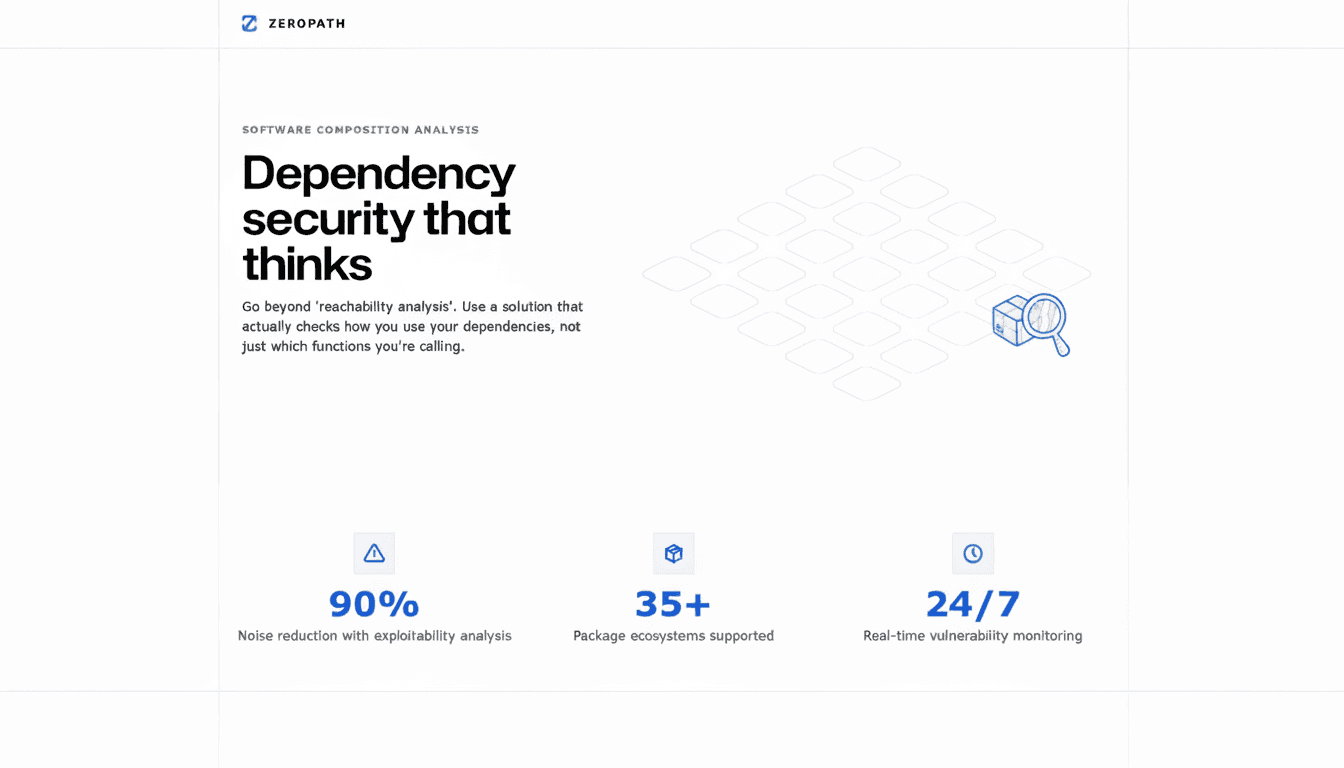
ZeroPath's SCA covers 13+ package ecosystems and builds complete dependency graphs from manifests, lockfiles, and compiled assets. Packages embedded in JARs, WARs, and Python wheels get caught even when no manifest lists them. Every finding links back to the originating manifest file and line number.
Reachability analysis then separates what's present from what's exploitable, filtering your queue to vulnerabilities where the affected code path is actually invoked.
ZeroPath is an RSAC 2026 Innovation Sandbox Top 10 finalist, runs 300,000+ scans per month across Fortune 500 customers, and has been validated on hardened open-source projects including curl, OpenSSL, and Linux. Joanna Wiggum, Director of Cybersecurity at Starbucks, put it plainly: "ZeroPath simply outperformed the alternatives in both raw results and developer experience. It found issues that traditional scanners could not find, with a fraction of the noise. Developers were actually excited to use it."
For remediation, multi-hop resolution walks up to 5 dependency levels to find an upgradable parent and automatically opens a fix PR. SBOM exports in CycloneDX, SPDX, or VEX format are available on demand.
Final Thoughts on Securing Your Software Supply Chain
Open source components now make up 70-90% of most codebases, which means your attack surface extends far beyond the code your developers write.
A few honest caveats worth noting: reachability analysis reduces alert volume, but the reduction varies by codebase size, language, and the extent to which your entry points are mapped. Depth of reachability coverage varies across the category, so it is worth asking vendors how they handle it for your specific ecosystems. The compliance frameworks discussed here are also moving targets: what satisfies FedRAMP SBOM requirements today may not satisfy next year's guidance. And automated fix PRs only close the gap if your test coverage is strong enough to catch regressions. SCA is still worth running. Results depend heavily on how it is configured and what it feeds into.
Software composition analysis finds vulnerabilities before they ship, but only if your tool maps transitive dependencies and filters findings by actual exploitability instead of theoretical presence. AI code generation adds another layer of complexity because manifest-based scanning misses dependencies that never touch your package manager. Most teams don't know how much of their findings queue is noise until they run reachability analysis. Schedule a demo. We'll walk through exactly how repo access is scoped, what data stays in your environment, and what your reachable attack surface looks like on your actual stack. No open-ended access required, and nothing leaves your environment without your team's sign-off first.
FAQ
SCA scan vs SAST scan?
SAST analyzes the code you write for vulnerabilities like SQL injection or authentication flaws, while SCA scans the third-party packages you import for known CVEs and license issues. You need both because open-source libraries now account for 70-90% of most codebases, and a gap in either layer becomes your attack surface.
Can SCA detect zero-day vulnerabilities in dependencies?
No. SCA flags known CVEs by matching dependencies against vulnerability databases like NVD or OSV. A freshly injected backdoor in a compromised package has no CVE entry yet, so manifest-based SCA passes it through. You need runtime behavioral analysis and package-provenance attestation to detect intentional supply-chain attacks.
What are the best SCA tools for reducing false positives?
Tools that perform reachability analysis reduce alerts by confirming whether your code calls vulnerable functions, not whether they exist in your dependency tree. ZeroPath's AI-native SCA provides reachability analysis across 13+ ecosystems, multi-hop transitive dependency resolution, and compiled asset scanning for packages hidden in JARs and Python wheels.
How does reachability analysis actually work in SCA scanning?
Reachability analysis traces your application's code paths to determine if vulnerable functions in dependencies are actually invoked during execution. Instead of flagging every vulnerable package in your tree, it filters to only those where the affected code is reachable from your entry points, turning a 500-vulnerability backlog into a 50-item actionable queue.
When should I require lockfiles for SCA scanning?
Always. Lockfiles provide accurate visibility into transitive dependencies, version resolution, and SBOM completeness that manifests alone cannot deliver. Without them, you miss the transitive dependencies that account for 77% of your total dependency tree and carry most of your exploitable surface area.