
Terraform, Pulumi, CloudFormation, Ansible, and OpenTofu all reliably stand up infrastructure. Where they differ is in multi-cloud portability, state management, syntax flexibility, and fit with your existing workflow. What none of them solve natively is whether the infrastructure you're provisioning is actually secure. An open security group ships to production the same either way.
TLDR
- IaC tools like Terraform, Pulumi, and OpenTofu handle provisioning, but security posture is separate: misconfigured IAM policies and open security groups are common IaC vulnerabilities that require static analysis before deployment.
- Terraform supports providers across AWS, Azure, GCP, and Kubernetes using HCL syntax, but it moved to BSL licensing in 2023, which restricts managed service offerings.
- OpenTofu is the MPL 2.0-licensed fork of Terraform with full compatibility and native state encryption using AES-GCM (with PBKDF2 as the key derivation method), critical when state files contain secrets.
- ZeroPath scans Terraform, Kubernetes, Docker, and CloudFormation for misconfigurations directly in your PR, with AI-generated remediation guidance that cuts false positives by up to 75%.
What are infrastructure as code tools?
Infrastructure as code (IaC) tools let you define, provision, and manage cloud and on-premises resources through code files instead of manual configuration. Write a config, commit it, and apply it. Your environment comes up the same way every time.
Declarative vs. imperative
IaC tools fall into two syntax models. Declarative tools (Terraform, CloudFormation, OpenTofu) let you describe the desired end state ("I want three EC2 instances with these properties") and the tool figures out how to get there. Imperative tools (Ansible) require you to script the exact steps: install this package, run this command, in this order. Imperative tools give you more control over the execution sequence for configuration management tasks.
Idempotence
Idempotence is the core guarantee that makes IaC reliable in production: applying the same configuration file multiple times produces the same result every time, without creating duplicate resources or triggering errors. Declarative tools get idempotence by design, since they compare the desired state against the actual state before making changes. Imperative tools require careful module authorship to achieve the same guarantee.
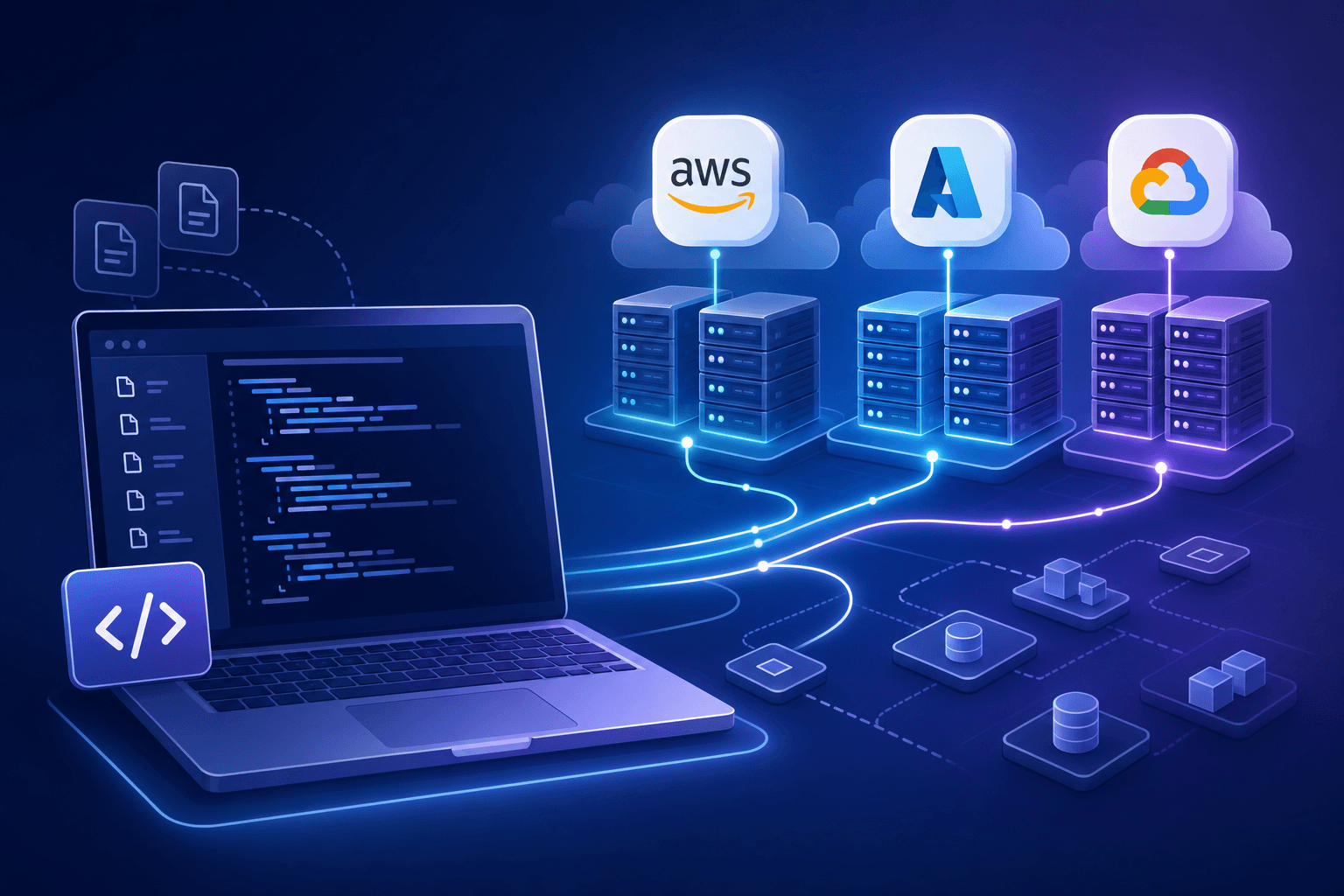
The core idea is treating infrastructure the same way you treat application code: version control for every change, automated testing before deployment, and reproducible environments on demand. For DevOps teams shipping frequently, manual infrastructure is a liability. IaC turns that into an auditable, reviewable process your whole team can work from.
What IaC does not cover is security posture. A Terraform config provisions an open security group or an overly permissive IAM policy just as reliably as it provisions anything else. Catching those issues requires static analysis of the IaC files themselves before apply runs, which is where a scanner like ZeroPath fits into the pipeline.
How we ranked infrastructure as code tools
These are the factors that consistently separate good IaC tooling from the rest in production environments:
- Multi-cloud support: whether the tool works across AWS, GCP, and Azure without forcing provider lock-in
- Declarative vs. imperative syntax: how you express the desired state, and whether drift detection is built in
- State management: how the tool tracks deployed resources and syncs real-world changes against your config
- Community ecosystem: depth of available providers, modules, and reusable components
- Learning curve: how quickly a team ships real infrastructure beyond tutorial configs
- CI/CD fit: how well the tool slots into GitOps pipelines and existing deployment workflows
ZeroPath for IaC security scanning
ZeroPath is an AI-native application security platform that covers IaC scanning as part of a unified workflow alongside SAST, SCA, and secrets detection. One scan, one dashboard, one PR check across all four.
ZeroPath scans Terraform, Kubernetes (YAML and Helm charts), Docker (Dockerfile and docker-compose), CloudFormation, Azure ARM templates, and GitHub Actions workflows. Within those formats, it detects misconfigurations across six categories:
- Network and access control: overly permissive security groups, unrestricted port exposure, public-facing resources without access controls
- Encryption and data protection: unencrypted storage (EBS, S3, Azure Blob), missing TLS/SSL, unencrypted database connections
- Identity and permissions: overly broad IAM policies, missing least-privilege enforcement, root and admin accounts without MFA
- Container security: containers running as root, privileged mode on, missing resource limits, images without digest pinning
- Logging and monitoring: disabled audit logging, missing CloudTrail, containers without health checks
- CI/CD pipeline security: insecure GitHub Actions configs, unpinned action versions, excessive workflow permissions, script injection via untrusted inputs
IaC scanning runs in parallel with SAST, SCA, and secrets detection on every PR scan. Each finding includes the affected resource (file, type, configuration block) and AI-generated remediation guidance. AI validation cuts false positives by up to 75% and completes scans in under a minute directly in your pull request.
In practice, ZeroPath has identified vulnerabilities in open-source repositories at Netflix, Hulu, and Salesforce. At customers like Commenda, it has found 4× more real vulnerabilities than Snyk.
Terraform
Terraform is HashiCorp's declarative IaC tool. It uses HCL (HashiCorp Configuration Language) to define a desired infrastructure state and syncs actual resources against that definition. HashiCorp, now an IBM subsidiary following the acquisition in February 2025, shifted Terraform from MPL 2.0 to a Business Source License (BSL) in 2023. It supports providers across AWS, Azure, GCP, Kubernetes, and SaaS APIs.
Where it fits
Teams managing heterogeneous multi-cloud environments that need a wide provider ecosystem. The plan/apply workflow produces an explicit diff before any change reaches production, making infrastructure changes reviewable in pull requests. Remote state storage (Terraform Cloud, S3 with DynamoDB locking, or similar) is required for any team sharing a codebase.
Limitations
- The BSL restricts use in managed services offered to external customers; a commercial agreement with HashiCorp is required for such use. Internal enterprise use is unaffected.
- No native state file encryption. State files frequently contain sensitive credentials, so teams must handle encryption at the storage layer.
- Security posture depends entirely on what's in the HCL files. Misconfigured IAM policies, open security groups, and unencrypted storage buckets are common IaC vulnerabilities that static analysis can catch before
terraform applyruns.
Pulumi
Pulumi lets teams define infrastructure in TypeScript, Python, Go, C#, Java, or YAML instead of a domain-specific language. It supports AWS, Azure, GCP, and Kubernetes. State management works through Pulumi Cloud or self-hosted backends like S3.
Where it fits
Teams that want infrastructure in the same language as their application code, in the same repo, and with a review process. Real loops, conditionals, and type checking from existing toolchains replace the workarounds that declarative languages require.
Limitations
- Pulumi's provider ecosystem is smaller than Terraform's; less-common cloud services may require workarounds or fall back to Terraform provider bridging.
- Debugging infrastructure failures is harder when the config is a real program with runtime behavior; stack traces are less immediately legible than a declarative diff.
- Engineers unfamiliar with a supported language face a steeper learning curve than with HCL, which is narrower in scope and easier to learn from scratch.
AWS CloudFormation
AWS CloudFormation is Amazon's native IaC service for provisioning and managing AWS resources through JSON or YAML templates organized into stacks. No additional tooling needs to be installed; it runs as a managed AWS service.
Where it fits
- AWS-only environments. Deep native integration means virtually any AWS resource is available without waiting for third-party provider support.
- Stack-based lifecycle management lets teams create, update, or delete an entire environment as a single unit.
- Drift detection flags when live resource configurations diverge from the template.
Limitations
- AWS-only. Teams managing any non-AWS infrastructure need a separate tool.
- Each stack is capped at 500 resources; exceeding that limit requires nested stacks, which add complexity.
- Template size is capped at 51 KB for direct API uploads or 1 MB when stored in S3. Deployments and rollbacks can be slow, and stuck resources sometimes require manual intervention to clear.
Ansible
Ansible is an agentless automation tool that handles configuration management and infrastructure provisioning through YAML playbooks. It connects over SSH with no agent required on managed hosts. Tasks are expressed imperatively. You describe the steps to take, not a desired end state.
Where it fits
- Configuration management across mixed environments: applying OS configuration, managing packages, or coordinating multi-step deployments.
- Teams that need a wide module library covering cloud providers, networking gear, and OS-level configuration in a format that does not require deep infrastructure specialization.
Limitations
- No state management. Ansible cannot track what it has provisioned or detect drift between playbooks and actual infrastructure.
- Sequential task execution makes complex dependency graphs harder to express and debug compared to tools with explicit dependency resolution, like Terraform.
- SSH-based architecture has throughput constraints at scale; managing thousands of nodes adds latency and coordination overhead.
OpenTofu
OpenTofu is the open-source fork of Terraform, created after HashiCorp's 2023 license change. It is governed by the Cloud Native Computing Foundation (CNCF) under the MPL 2.0 license and maintains full compatibility with Terraform's HCL syntax and provider ecosystem.
Where it fits
- Teams running Terraform that want to avoid BSL restrictions. The CLI is a drop-in replacement; existing CI/CD pipelines require no modification.
- Teams that need native state encryption. OpenTofu encrypts state at rest using AES-GCM, with PBKDF2 as the key derivation function; it's relevant when state files contain secrets like database passwords or API keys.
Limitations
- Smaller commercial support ecosystem than Terraform. Teams that relied on HCP Terraform's managed offerings have no direct equivalent in OpenTofu.
- Community governance means feature delivery depends on contributor availability and community prioritization, which can be less predictable than a single commercial vendor's roadmap.
- As a fork, OpenTofu inherits Terraform's lack of native security scanning; misconfigured HCL still ships to production without static analysis.
Feature comparison table of infrastructure as code tools
ZeroPath is an IaC security scanner, not a provisioning tool. The table below shows how it fits as a security layer alongside provisioning tools, not as a direct alternative to them.
Feature | ZeroPath | Terraform | Pulumi | AWS CloudFormation | Ansible | OpenTofu |
IaC security scanning | Yes | No | No | No | No | No |
Multi-cloud support | Yes | Yes | Yes | No | Yes | Yes |
AI-powered validation | Yes | No | No | No | No | No |
Automated remediation guidance | Yes | No | No | No | No | No |
PR integration | Yes | Yes | Yes | Yes | Yes | Yes |
False positive reduction | Yes | No | No | No | No | No |
Why ZeroPath for IaC security
The provisioning tools covered here do one thing well: defining and deploying architecture. They leave security posture entirely to you.
Most standalone IaC scanners stop at detection. ZeroPath detects, generates a fix, and verifies the fix after the PR merges. When a finding is resolved in a PR, ZeroPath re-runs verification against the merged code and marks the issue resolved if confirmed. That closes the loop instead of adding to a backlog.
Running IaC scanning as a separate tool means a separate dashboard, separate alert routing, and separate triage workflow on top of whatever you already use for SAST and SCA. ZeroPath runs all of them in a single PR check. A pull request that touches both application code and infrastructure config gets SAST, SCA, secrets, and IaC results in one pass, posted as inline PR comments with per-finding remediation guidance.
The AI validation layer matters for IaC in particular. Rule-based IaC scanners frequently flag conservative defaults that aren't exploitable in context. A security group open on a port that's blocked at the network perimeter is one common example. ZeroPath's AI validation cuts that noise by up to 75%, so the findings that reach your team are the ones worth acting on. Provisioning tools tell you what infrastructure you have. ZeroPath tells you what's wrong with it before it reaches production.
Final thoughts on infrastructure as code tools
Most teams pick their IaC tool based on syntax comfort and cloud coverage, which makes sense until you realize none of them tell you when your config is about to ship an open security group or an unencrypted database. You can version-control and automate your infrastructure all day, but if you're not scanning those files for misconfigurations in the same pipeline, you're accelerating the deployment of misconfigured infrastructure. Request a ZeroPath demo to see what IaC security scanning looks like when it runs in the PR, not after deployment.
FAQ
Which infrastructure-as-code tool works well for teams just starting with IaC?
Terraform or OpenTofu offer the gentlest learning curve for teams new to IaC while maintaining production-grade capabilities, with declarative HCL syntax that's more approachable than programming in Python or TypeScript. For AWS-only environments, CloudFormation requires zero setup and integrates natively with every AWS resource.
How do I choose between Terraform and OpenTofu for multi-cloud infrastructure?
OpenTofu maintains full compatibility with Terraform's syntax and provider ecosystem while staying genuinely open-source under MPL 2.0, making it the direct choice if you want to avoid HashiCorp's Business Source License restrictions. The CLI is a drop-in replacement, so existing pipelines work without modification, and OpenTofu adds native state encryption that Terraform still lacks.
What's the difference between provisioning tools and IaC security scanning?
Provisioning tools like Terraform and Pulumi define and deploy infrastructure, but they don't catch security misconfigurations before they reach production. IaC security scanning detects issues like overly permissive IAM policies, unencrypted storage, or containers running in privileged mode directly in your pull request before the infrastructure gets provisioned.
Can I scan IaC security issues in the same workflow as application vulnerabilities?
Yes, tools like ZeroPath scan Terraform, Kubernetes, Docker, and CloudFormation alongside SAST, SCA, and secrets detection in a single PR check, so you catch infrastructure misconfigurations and application code vulnerabilities in one pass instead of managing separate security tools with separate dashboards.
When should I use Pulumi instead of Terraform for infrastructure as code?
Pulumi fits teams that want infrastructure defined in the same language as their application code (TypeScript, Python, Go, C#, Java, or YAML) with real loops, conditionals, and type checking from existing toolchains instead of learning HCL. This removes the workarounds that declarative tools require and keeps the infrastructure in the same repo and review process as application code.