Aikido has carved out a solid niche by consolidating SAST, SCA, DAST, and cloud security into a single interface, but no single tool fits every organization. If you're comparing alternatives to Aikido Security, you're likely dealing with one of the common scaling challenges with bundled AppSec solutions: false positives that drain engineering resources, limited customization for your organization's threat model, or scan depth that fails to scale with complex codebases.
TLDR:
- Aikido Security consolidates nine security functions into one interface, claiming 85% fewer false positives
- ZeroPath uses AI agents to find complex vulnerabilities that traditional pattern-matching misses
- Semgrep offers open-source static analysis with strong customization for teams willing to manage rules
- Checkmarx targets enterprises, but scan times of 25-45 minutes break fast CI/CD workflows
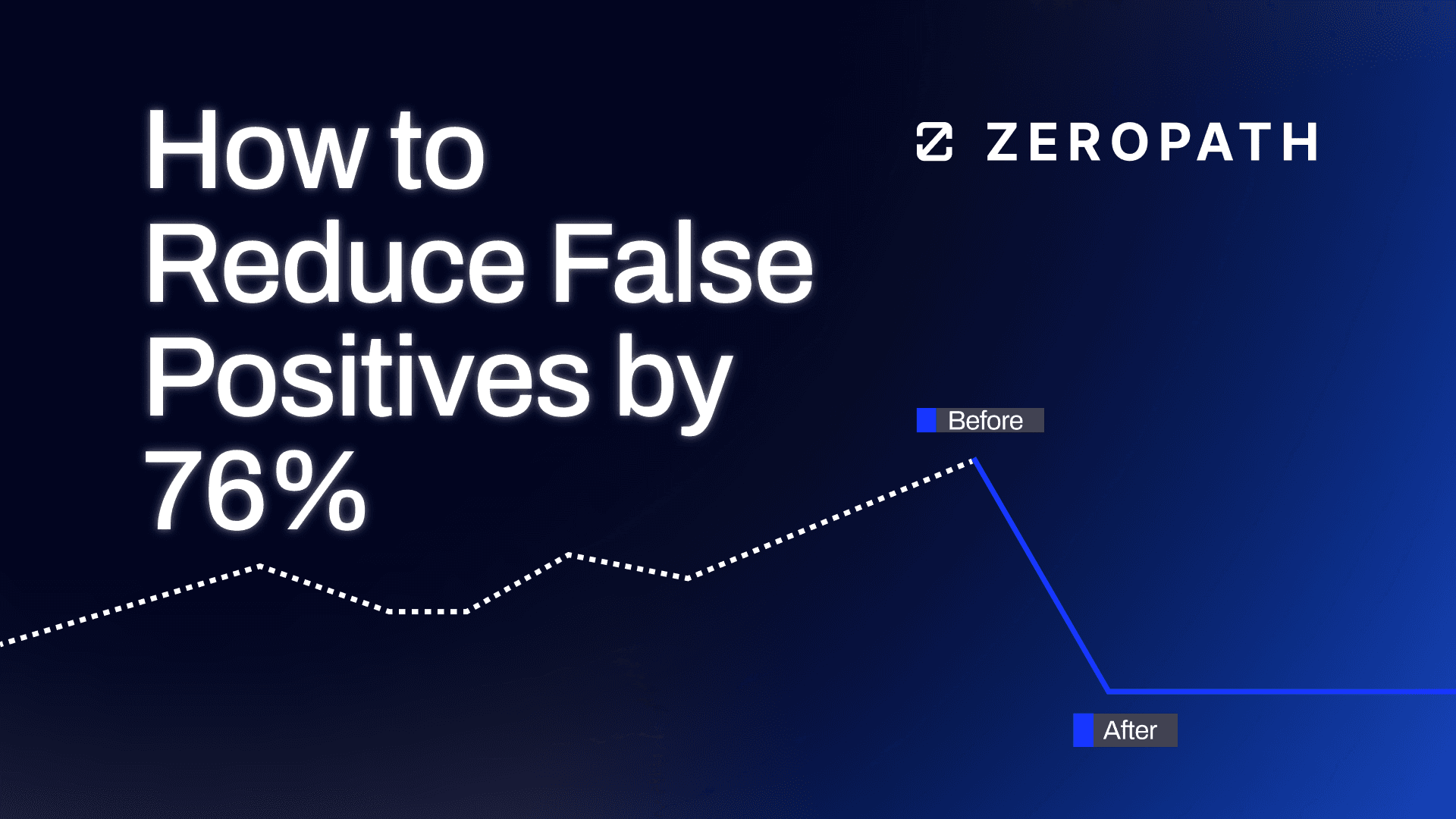
- ZeroPath delivers 75% fewer false positives through AI validation that understands actual code context
What Is Aikido Security and How Does It Work?
Aikido Security is a Belgian-born ASPM and CSPM tool that bundles nine security functions into one interface. SAST, DAST, SCA, secrets detection, container scanning, IaC, and runtime protection all work together. And Aikido is widely used across organizations and by developers.
The core pitch is noise reduction. AutoTriage claims to reduce alert noise by 95% through deduplication, reachability analysis, and cross-scanner correlation. A vulnerability appearing in three different tools shows up once, only if that code path is actually reachable. AutoFix then generates one-click pull requests for remediation.
Language coverage includes JavaScript, TypeScript, Python, Go, Ruby, PHP, Java, Rust, Scala, Kotlin, Swift, Dart, Elixir, C/C++, and more, 19 languages in total. The Zen in-app firewall blocks live attacks and monitors LLM usage without code changes. Aikido also claims 85% fewer false positives compared to traditional scanners.
Key Strengths
AutoFix generates one-click pull requests that push remediation directly into development workflows, cutting the context-switching overhead that typically kills developer adoption of security tooling. PR scan times stay under 1 minute for most checks, preventing security gates from becoming bottlenecks in fast-moving CI/CD pipelines. For mid-market teams that need broad coverage without adding dedicated security headcount, Aikido delivers a unified interface and more predictable pricing than per-developer models.
Why Consider Aikido Security Alternatives?
Aikido Security has carved out a niche in the consolidated AppSec space, pulling together SAST, SCA, DAST, secrets detection, and cloud security into a single interface. For organizations seeking complete coverage without expanding headcount in dedicated security functions, that value proposition is clear. The application security market is projected to grow from $41.16 billion in 2026 to $66.03 billion by 2031 at a 9.9% CAGR, according to application security market research, reflecting how broadly organizations are investing in protecting their software supply chains.
But consolidation has tradeoffs. Organizations operating at scale or with mature AppSec programs often encounter the same friction points: limited customization, false-positive noise that drains security teams (55% of security leaders report too many false positives, per Cisco's State of Security 2025), and scanning depth that struggles to keep pace with complex codebases. Pricing models can also shift meaningfully as organizations scale.
If any of those are familiar problems, it's worth knowing what else is out there.
Aikido Security Alternatives in May 2026
Aikido Security has built a solid reputation in the AppSec space, but no single tool fits every organization. Depending on your company's scale, engineering maturity, and threat model, other tools may better align with your security strategy.
ZeroPath: Best Aikido Security Alternative
Aikido's bundled open-source scanners generate alert volumes that can overwhelm security teams. ZeroPath's AI-native approach goes after that problem directly: a multi-stage AI pipeline filters out non-exploitable findings before they reach your queue, delivering 75% fewer false positives than traditional tools. Where Aikido's reachability analysis struggles with complex codebases, ZeroPath's AI agents reason through code with security engineering expertise, surfacing complex, chained vulnerabilities and business-logic flaws that pattern-matching cannot find. Auto-generated pull requests with verified fixes cut the manual remediation overhead that grows as your codebase scales.
Snyk
Snyk's SCA is its strength. A large vulnerability database and deep IDE integrations give Snyk an edge for supply chain risk, if that is the specific Aikido gap you are trying to close. The SAST layer, Snyk Code, was acquired from DeepCode in 2020 and grafted onto Snyk's dependency-management core. Snyk Code runs pattern-based analysis that finds known vulnerability signatures but cannot reason about code intent. Business-logic flaws, authorization bypasses, and IDORs fall entirely outside Snyk Code's scope. Multi-file data flow issues also slip through. Pricing scales per developer and grows expensive for teams seeking full coverage across SAST, SCA, and secrets. Teams at Commenda who assessed Snyk first found that ZeroPath surfaced 4x more real vulnerabilities, with more than half being business-logic bugs that Snyk missed entirely.
Semgrep
Semgrep's rules engine gives security teams control over detection logic, the Community Edition engine is open source under LGPL 2.1, and support for 35+ languages covers most stacks. That flexibility is real. But it has a ceiling: Semgrep can only find what someone has already written a rule for. Business-logic flaws, auth bypasses, and application-specific issues have no fixed pattern, so they lack rules and coverage. Rule libraries require ongoing maintenance from security engineers. Coverage drifts as codebases evolve, and new frameworks go undetected until someone writes detection for them. Autofix, currently in beta and limited to paid tiers and GitHub Cloud repositories, can open draft PRs for findings but takes 2 to 10 minutes per fix, a meaningful gap compared to tools that post inline suggestions directly in the PR diff. For organizations assessing Aikido alternatives because of false-positive volume or scan-depth concerns, Semgrep trades one set of constraints for another.
GitHub Advanced Security
For GitHub-native teams, GHAS removes the integration overhead of deploying a third-party tool. CodeQL builds a relational semantic database covering AST, control flow, data flow, and call graph, and findings surface natively in PRs and the Security tab. The limitations are hard to route around. GHAS is GitHub-only. Any repositories on GitLab, Bitbucket, or Azure DevOps have zero coverage. CodeQL requires a successful build for compiled languages, so build failures and complex monorepos create gaps. The active committer billing uses a rolling 90-day window that produces unpredictable cost spikes as contractors and cross-repo commits accumulate. IaC scanning, container scanning, and cloud posture are entirely outside the scope of GHAS. Most critically, CodeQL only finds vulnerabilities that someone wrote a query to detect. Business-logic flaws and auth bypasses, anything requiring reasoning about developer intent, are structurally out of reach regardless of how much CodeQL is tuned.
Checkmarx
Checkmarx offers broad language coverage across 35+ languages, which can matter if your codebase spans less common stacks. But for the problems that actually drive teams away from Aikido (false-positive volume, scan depth on complex codebases, detection of business-logic flaws), Checkmarx doesn't move the needle on any of them. False positives are worse, not better: the broader rule set generates more noise, not less. Full scans take 25 to 45 minutes on medium-sized projects, making PR-blocking security gates a non-starter for teams shipping frequently. Standing up the solution requires dedicated security engineering resources and a lengthy procurement cycle. Teams assessing Checkmarx as an Aikido replacement are often trading one set of frustrations for a heavier, slower, more expensive version of the same core problems.
Feature Comparison: Aikido Security vs Top Alternatives
Feature | Aikido Security | ZeroPath | Snyk | Checkmarx SAST | Semgrep |
|---|---|---|---|---|---|
SAST Scanning | Yes (open-source based) | Yes (AI-native) | Yes (DeepCode AI) | Yes (enterprise-grade) | Yes (pattern-matching) |
SCA with Reachability | Basic reachability | Available | Available | Yes (paid tier) | |
Business Logic Detection | No | Yes | No | No | No |
False Positive Rate | 85% reduction claimed | 75% fewer false positives | Medium | High | High |
Language Support | 19 languages | 15+ languages | 19+ languages | 35+ languages | 35+ languages |
PR Scan Speed | Under 1 minute | Under 1 minute | Fast | 25-45 minutes (full scan) | Fast |
Auto-Fix Capability | AI AutoFix | AI auto-patch with PRs | DeepCode AI fixes | Limited | AI Autofix (paid, beta) |
Secrets Detection | Yes (multi-engine) | Yes (AI-validated) | Basic | Available | Yes |
IaC Scanning | Yes | Yes | Yes | Yes | Yes |
Pricing Model | Flat-rate | Per-developer | Per-developer | Enterprise custom | Free/Paid tiers |
Why ZeroPath Is the Best Aikido Security Alternative
ZeroPath takes a different approach to application security than most tools in this space. Where Aikido bundles together a wide array of scanners with varying depths, ZeroPath goes deep into AI-driven vulnerability detection with a focus on reducing false positives that waste engineer time.
- Each confirmed finding includes a data flow path from source to sink, attack exploitation steps, and fix guidance, not a CWE reference number that sends your team to Google.
- PR scans run in under one minute and post inline comments directly on the affected diff lines, so developers get specific feedback in the same workflow where they're already making decisions.
- The multi-stage AI pipeline runs a secondary validation pass on every true-positive before recording it. Findings that reach your queue have already cleared two rounds of review, not one.
If your current scanner is generating tickets faster than your team can close them, that is a pipeline problem, not a staffing one. ZeroPath's architecture is built around that reality.
Final Thoughts on Picking the Right Scanner
If your organization requires an Aikido Security alternative for deep analysis over broad coverage, or if false positives from traditional scanners are consuming serious security engineering resources, ZeroPath's AI-native approach may better align with your security strategy. ZeroPath's detection engine targets complex vulnerabilities that static rules miss, while keeping alert volumes manageable for security teams. See ZeroPath in action against your codebase to assess alignment with your AppSec requirements.
FAQ
How does AI-native vulnerability detection differ from pattern-matching tools like Aikido?
AI-native tools like ZeroPath reason through code context and data flow to understand actual exploitability, while pattern-matching tools flag potential issues based on static signatures. There are fewer false positives. ZeroPath reports 75% fewer. It can catch business-logic vulnerabilities that conventional scanners miss entirely because they can't infer developer intent.
When should you consider moving away from a consolidated scanner like Aikido?
If you're spending more engineering hours triaging false positives than fixing real vulnerabilities, or if your team needs deeper detection for complex attack chains that simple reachability analysis doesn't catch. Also, reconsider when scan times start blocking PR workflows or when pricing scales unfavorably with headcount growth.
What should AppSec teams focus on when comparing Aikido alternatives?
Look at the actual false-positive rates in your codebase, not marketing claims. Test PR scan speed under real CI/CD constraints. Anything over 5 minutes kills adoption. Verify that the tool can detect business-logic flaws beyond technical CVEs. Check whether auto-fix PRs generate production-ready patches or create more toil.
Can you replace multiple security tools with a single system without losing coverage?
Consolidation works if the unified system maintains depth across each function (SAST, SCA, secrets, IaC) instead of offering shallow implementations of everything. The risk is trading specialist accuracy for interface convenience. Teams with mature AppSec programs often find that dedicated best-of-breed tools for each category outperform all-in-one solutions when detection quality matters more than dashboard simplicity.
What's the real cost difference between flat-rate and per-developer pricing models?
Flat-rate pricing, like Aikido's, benefits smaller teams but can become expensive at scale if the base cost is high. Per-developer models from vendors like Snyk or ZeroPath scale linearly with headcount, which hurts early but becomes predictable. Calculate total cost at your projected headcount in 12-24 months, not your current team size, to avoid budget surprises during growth phases.