
Summary
ZeroPath Research discovered an authenticated IDOR vulnerability in AutoGPT that allows any logged-in user to hijack any other user's chat session with a single PATCH request. The attacker needs only the target session_id — there's no requirement to share an organization, agent, or prior access with the victim.
After the hijack, the attacker reads the full conversation history of the session, and the original owner is locked out of their own data. Chat sessions in AutoGPT carry conversation history with the agent, credentials metadata, agent execution context, and any files or sensitive content the user pasted into the chat.
The issue is tracked as CVE-2026-30950 and GHSA-q58p-v9r9-7gqj, and was patched in autogpt-platform-backend version 0.6.51. MITRE assigned a CVSS 3.1 base score of 7.1 (high).
Impacted Software
| Vulnerable Versions | Patched Versions |
|---|---|
| >= 0.6.36, < 0.6.51 | >= 0.6.51 |
Timeline
- 2026-03-06 — Issue reported to AutoGPT maintainers (private security advisory GHSA-q58p-v9r9-7gqj created)
- 2026-03-08 — Fix committed as eca7b5e793 and shipped in
autogpt-platform-beta-v0.6.51 - 2026-05-11 — GHSA-q58p-v9r9-7gqj published by the AutoGPT maintainers
- 2026-05-18 — CVE-2026-30950 published
AutoGPT
Background
AutoGPT is a workflow automation platform for building, deploying, and managing continuous AI agents. The platform's backend (autogpt-platform-backend) is a FastAPI service that brokers chat sessions between end users and agents — each session carries the message history, tool invocations, and credentials context for one conversation.
Chat sessions and ownership
Each chat session is a database object with a session_id (UUIDv4) and a user_id representing the owner. Sessions are cached in Redis (12-hour TTL) and read with a get_chat_session(session_id, user_id) helper that performs ownership validation when user_id is supplied. The helper has a dual mode: when called with user_id=None, the docstring explicitly notes this is "admin/system access" and the ownership check is skipped — meant for internal lookups that aren't tied to a particular caller.
The platform also exposes an assign-user endpoint, designed to let a freshly-logged-in user claim an anonymous session they created before authenticating. That endpoint is where the bypass lives.
CVE-2026-30950: Hijacking any user's chat session with one PATCH
Practical Impact
A logged-in AutoGPT user is having a private conversation with the copilot — agent output, customer details, credentials they've pasted into the chat. A completely unrelated user, signed into the same instance with no shared organization, agent, or prior access, only needs the victim's session_id to take the conversation over. That id is a UUIDv4, so it's not brute-forceable, but it leaks routinely through referer headers, shared links, support tickets, server logs, and screen shares.
One PATCH request later, the attacker reads the victim's entire chat history, and the victim is silently locked out of their own session — same URL, same JWT, same browser, but the chat area never loads.
The walkthrough below uses two real browser sessions against AutoGPT at the last vulnerable tag (autogpt-platform-beta-v0.6.50). The green banner above each viewport is the victim, the red banner is the attacker.
1. The victim's private chat
The victim is using the copilot normally. The session contains a plain-text mention of a leaked Stripe key, the rotation status, the customer name, and a draft of the customer-facing incident notification:

Nothing about this view is unusual — it's a routine internal AI workflow. The point of the walkthrough is what an unrelated user can do with the URL of this session.
2. The attacker has no access (pre-exploit)
The attacker logs into the same AutoGPT instance with their own account and opens /copilot. The sidebar reads "No conversations yet" — expected behavior of a properly isolated multi-tenant app:
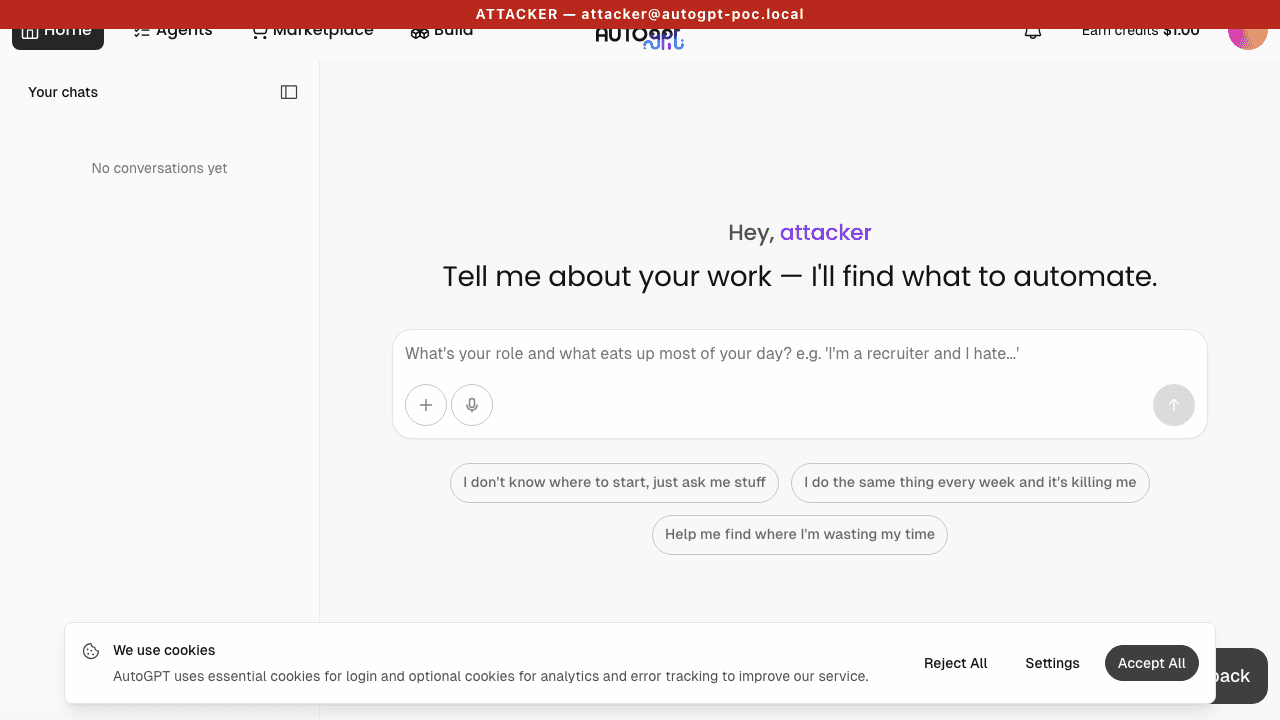
The attacker then tries to load the victim's session directly by guessing the URL — /copilot?sessionId=<victim_session_uuid>. Pre-exploit, the backend correctly rejects the read; the UI shows a loading spinner and the input is disabled:
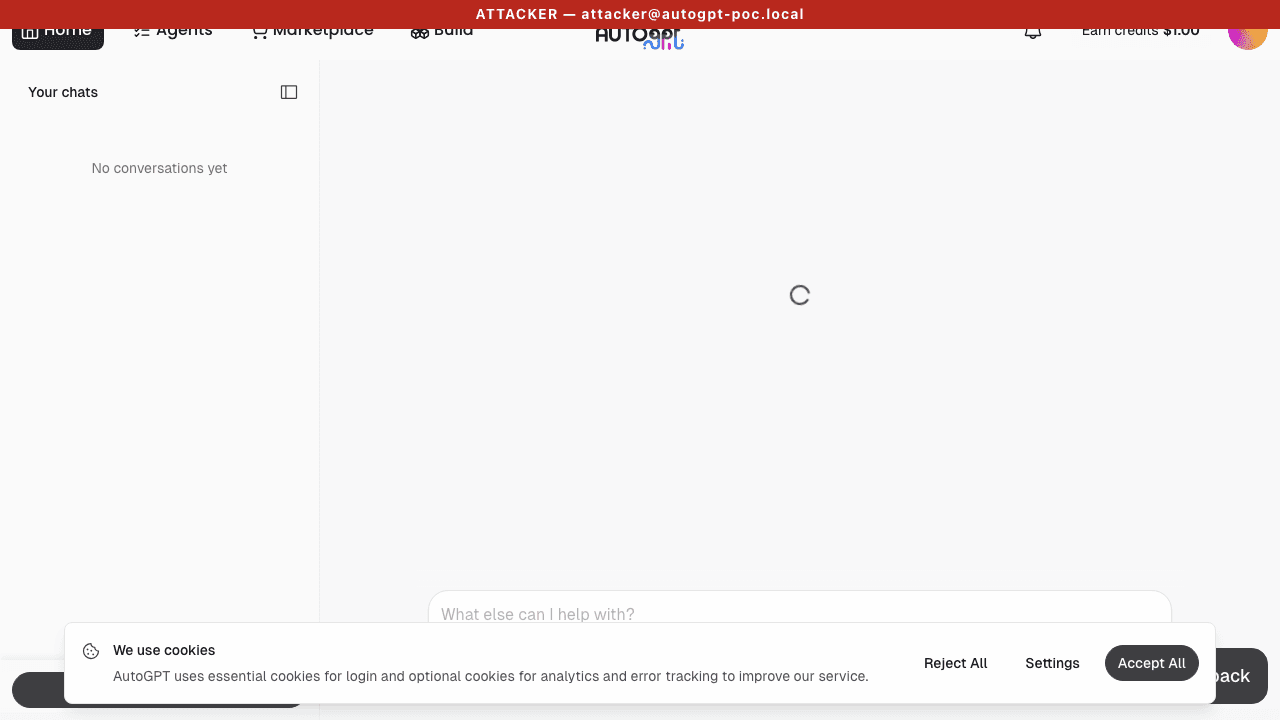
So far, so good — sessions are isolated by ownership at read time.
3. The exploit — one PATCH request
From the attacker's already-authenticated session, a single PATCH:
curl -X PATCH \
  -H "Authorization: Bearer <attacker_jwt>" \
  http://<host>/api/chat/sessions/<victim_session_id>/assign-user
# HTTP/1.1 200 OK
# {"status":"ok"}
The endpoint accepts the request, flips the session owner in the Redis cache to the attacker, and returns 200. No interaction from the victim is required.
4. The attacker reads the victim's private messages
The attacker reloads the exact URL that was blocked in step 2. This time the per-session API read (cache hit) returns userId == attacker, the ownership filter matches, and the full chat history renders:
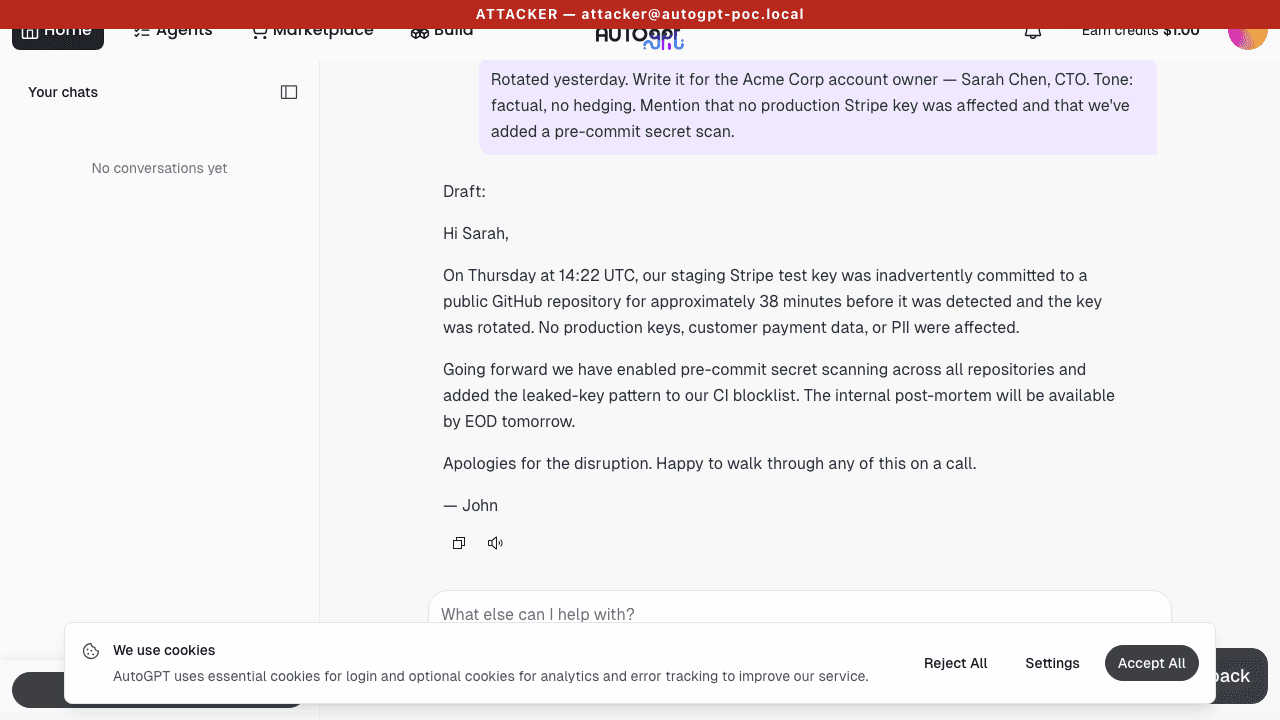
The leaked key, customer name, and draft email — all visible to a user who had nothing to do with the session moments ago. This is the confidentiality impact that gives the CVE its C:H rating.
5. The attacker's sidebar is still empty (cache-only hijack)
Worth pointing out: the attacker's session list (left sidebar) is still empty even after the hijack. The sidebar is rendered from the LIST endpoint, which reads straight from Postgres — and the database row's userId was never updated:
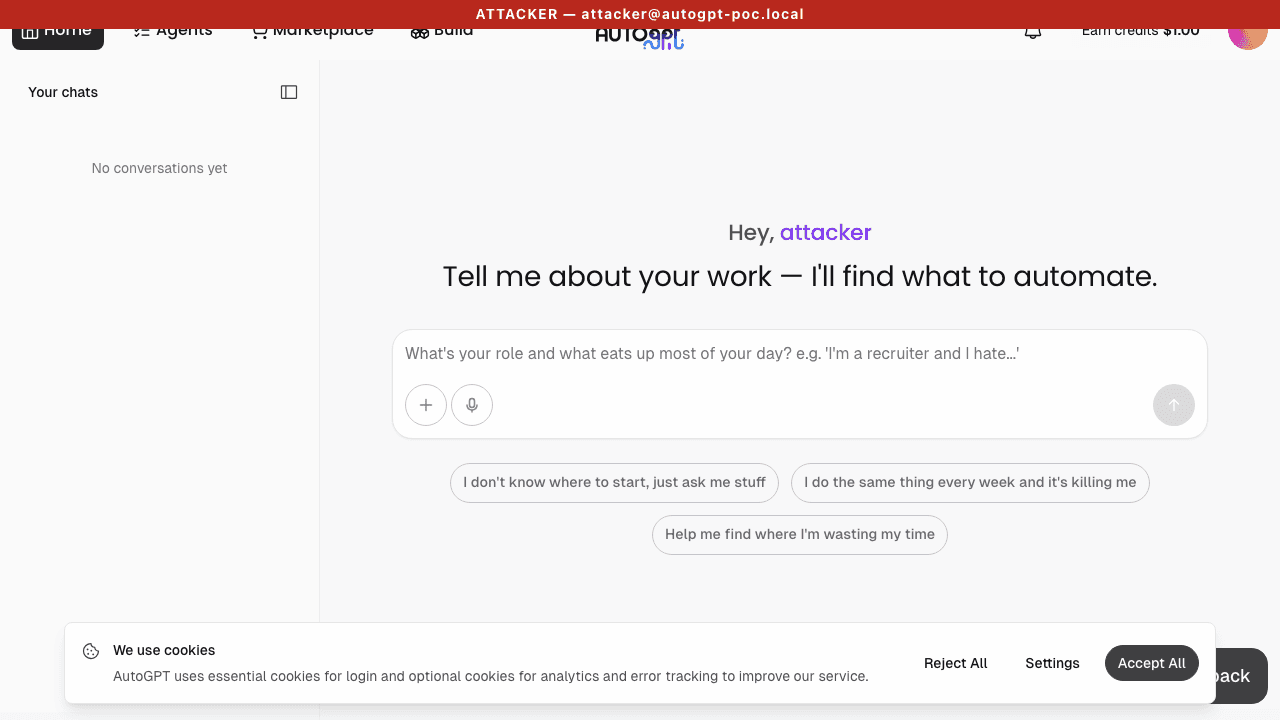
For the attacker this doesn't matter — they already have the URL and the read works. But it also explains why a victim won't necessarily notice anything is wrong from their own sidebar.
6. The victim is locked out of their own session
The victim's sidebar still lists their session (DB unchanged). They click it — same URL they used five minutes ago. The per-session API call hits the cache, which now says userId == attacker, the ownership filter rejects the victim's JWT, and the chat area never loads:
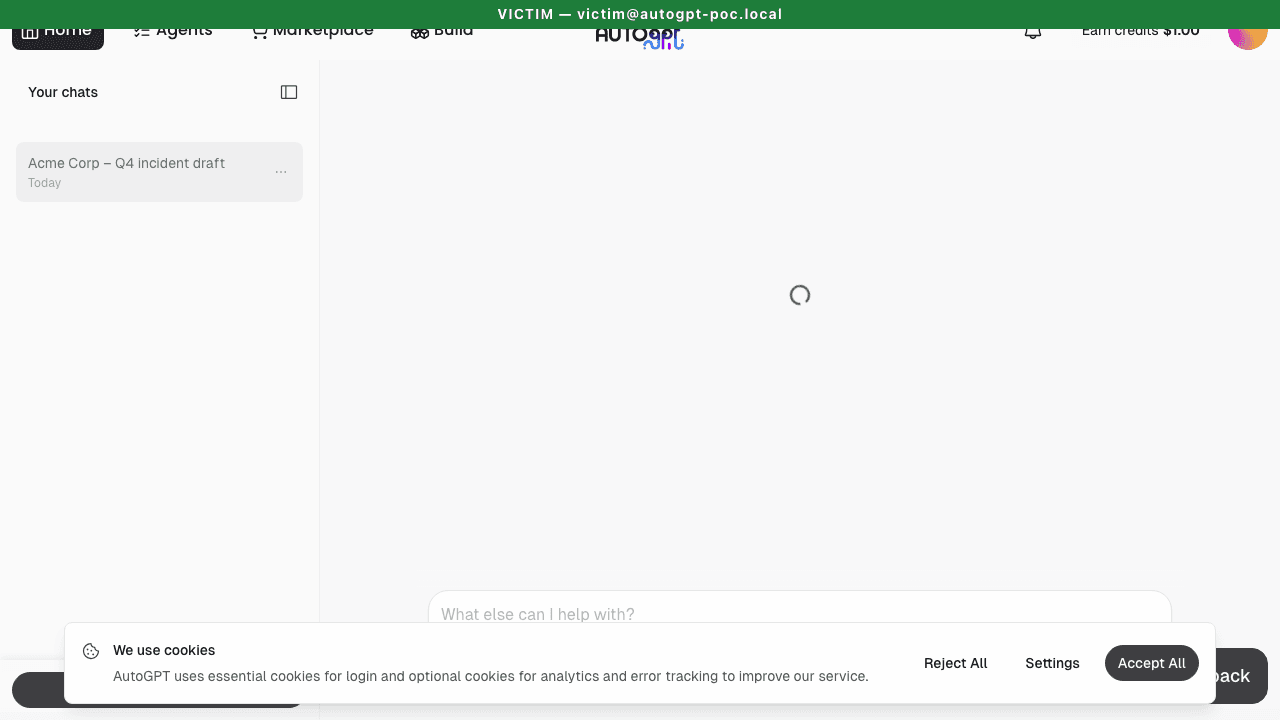
This is the availability impact (A:L): the victim can no longer access their own conversation history. The chat area renders the same loading-spinner state the attacker had in step 2 — a frustrating "is it broken?" UX with no surfaced error message — until the cache entry expires.
The Details: Bypassing ownership checks by passing None to the data layer
Overview
The PATCH /api/chat/sessions/{session_id}/assign-user endpoint authenticates the caller but performs no check that the caller currently owns the target session. The service function it calls deliberately passes user_id=None to the data accessor, which the accessor treats as a privileged system lookup and returns the session regardless of who owns it. The service then overwrites session.user_id with the caller's ID and persists the change to Redis and the database.
Preconditions
- An authenticated account on the target AutoGPT instance (any standard signed-up user works).
- Knowledge of the victim's
session_id. Session IDs are UUIDv4, so they're not brute-forceable, but they appear in URLs, referer headers, server logs, shared links, support tickets, and screen shares.
The three layers of the bypass
The vulnerability is established once at each of three layers, and each layer's behavior on its own looks defensible — it's the composition that breaks.
Layer 1 — the route handler. In autogpt_platform/backend/backend/api/features/chat/routes.py, around lines 753–776, the endpoint requires a valid JWT but does not check that the caller owns the session referenced in the URL:
@router.patch(
    "/sessions/{session_id}/assign-user",
    dependencies=[Security(auth.requires_user)],
    status_code=200,
)
async def session_assign_user(
    session_id: str,
    user_id: Annotated[str, Security(auth.get_user_id)],
) -> dict:
    await chat_service.assign_user_to_session(session_id, user_id)  # ZP: no ownership check on session_id
    return {"status": "ok"}
session_id is taken directly from the URL path and is attacker-controlled. user_id comes from the caller's JWT and is the attacker's own ID. Both flow into the service layer with no further gating.
Layer 2 — the service function. In autogpt_platform/backend/backend/copilot/service.py, around lines 291–303, assign_user_to_session fetches the session by ID with user_id=None, then overwrites the owner:
async def assign_user_to_session(session_id: str, user_id: str) -> ChatSessionInfo:
    session = await get_chat_session(session_id, None)  # ZP: None disables ownership filter in the data layer
    if not session:
        raise NotFoundError(f"Session {session_id} not found")
    session.user_id = user_id
    session = await upsert_chat_session(session)
    return session
Other endpoints in the same file (GET /sessions/{session_id}, DELETE /sessions/{session_id}) correctly forward the authenticated user_id to get_chat_session, so the ownership check fires. This endpoint is the outlier.
Layer 3 — the data accessor. In autogpt_platform/backend/backend/copilot/model.py, around lines 355–366, the ownership check short-circuits when user_id is None:
session = await _get_session_from_cache(session_id)
if session:
    if user_id is not None and session.user_id != user_id:  # ZP: bypassed when user_id is None
        logger.warning(f"Session {session_id} user id mismatch")
        return None
    return session
The same check exists on the database fallback path a few lines below. The docstring on get_chat_session documents user_id=None as "admin/system access," so from this function's perspective the behavior is by design — it just trusts that callers pass None only when they have already authorized the request themselves.
Persistence and lockout
After the service overwrites session.user_id, upsert_chat_session writes the modified session to both the database and Redis. The Redis write (cache_chat_session in model.py) serializes the full session object including the attacker's user_id and stores it with a 12-hour TTL. From that point on:
- The attacker calling
GET /api/chat/sessions/{session_id}passes the now-cached ownership check and receives the full message history. - The victim calling the same endpoint fails the ownership check (the cached
session.user_idno longer matches their JWT subject) and receives 404 — the same lockout symptom you'd see if the session had been deleted.
A note on the DB layer: db.update_chat_session does not update the userId column directly, so initially the database row retains the original owner while the Redis cache is poisoned. However, any subsequent upsert of the session (for example, when the attacker sends a follow-up message and the session is re-saved end-to-end) writes a session record carrying the attacker's user_id, making the change durable beyond the 12-hour cache TTL.
POC
Full working POC with a Docker Compose setup that boots AutoGPT at the last vulnerable tag (autogpt-platform-beta-v0.6.50), provisions an attacker and a victim account, and runs the single-PATCH hijack end-to-end. The POC verifies the attacker has no pre-exploit access, fires the request, then confirms ownership has transferred and the victim is locked out.
Mitigation
- Upgrade
autogpt-platform-backendto 0.6.51 or later. The fix is in commiteca7b5e7. - If you cannot upgrade immediately, treat
PATCH /api/chat/sessions/{session_id}/assign-useras an authenticated-but-unauthorized endpoint — block it at your gateway, or accept that any authenticated user can hijack any session whose ID they can obtain.
Takeaways
The bug here isn't in any single function — it's in how three functions agree on responsibility. The route handler trusts the service to authorize. The service passes None and trusts the data layer not to expose anything dangerous. The data layer treats None as a privileged sentinel and trusts callers to only use it from system code. None of those individual decisions is obviously wrong if you only look at one file at a time, and that's exactly why this kind of finding survives review.
What makes it interesting from a tooling angle is that it's a pure semantic bug — there's no taint flowing into a dangerous sink, no string concatenation, no missing escape. Every value at every step is the "right" type. The flaw is that an authorization sentinel (user_id=None meaning "skip the check") was reachable from a code path that hadn't done the check yet. That's the kind of cross-function policy violation that's well-suited to LLM-driven analysis of how authorization decisions actually compose across a codebase, rather than pattern matching on individual sinks.